
Before formation: three determining decisions
The Nevis trust has, for a long time, been a solid structure chosen by international players to protect their assets under a highly secure framework. They choose to set up a Nevis trust because the jurisdiction doesn't enforce foreign rulings, has short statutes of limitations, and stipulates an expensive bond to even start legal action.
For those who have already decided to set up a Nevis trust, this guide presents the basics of the process, the structure, and the importance of the trustee.
Key facts about the Nevis trust
- Three available packages through Mundo (bronze, silver, gold)
- The jurisdiction doesn't recognize foreign rulings
- Nevis has a territorial taxation system
- Two-year statute of limitations
- Private trustees allowed
- No public records: the settlor's information appears only in the registered agent's records
Revocable or irrevocable, and why the choice is not reversible in practice
The first decision to make before registration is whether the trust will be revocable or irrevocable. Irrevocable trusts are less flexible but safer, while a revocable trust allows the settlor to maintain some level of control in the long run.
The revocable trust offers more flexibility; hence, it adapts better to families with changing needs, but it's not without challenges. Forming a revocable trust may be interpreted as a decision to maintain a certain control over the assets, which can leave them exposed to claimants. In court, someone can prove that the purpose of the trust was not asset protection but avoiding financial responsibilities.
On the other side of the equation, there's the irrevocable trust, which is as solid as a rock, but only if the family accepts losing control and compromising on flexibility.
Who is the typical settlor: sectors and professions where trusts can be particularly useful
A common misconception is that the trust structure is only for the ultra-rich; however, this is far from reality. A trust is a reliable asset protection tool that can shelter any asset. If the head of a family has only one house and wants to protect it, he or she can already start a trust.
Naturally, there are several types to which the structure fits better: professionals who work in litigation-exposed fields, like doctors, lawyers, or business owners.
The Nevis trust formation is a good solution because they can put valuable ownership under it, such as properties, bank accounts, or their life savings, before they face a lawsuit. Since they are operating in risky areas, they can rest assured they won't lose it all in the blink of an eye.
Editor’s advice: Trusts function as an asset protection tool if they are formed as a preventive measure, that is, before a lawsuit appears. If the trust is created specifically to avoid an existing claim, it won’t be legit.
What assets are intended for the trust and in what order
A trust can hold basically any valuable or asset, from real estate (whether primary residence or vacation homes), to bank accounts (whether savings or investment accounts), corporate shares, and valuable items like jewelry, art, or collectibles.
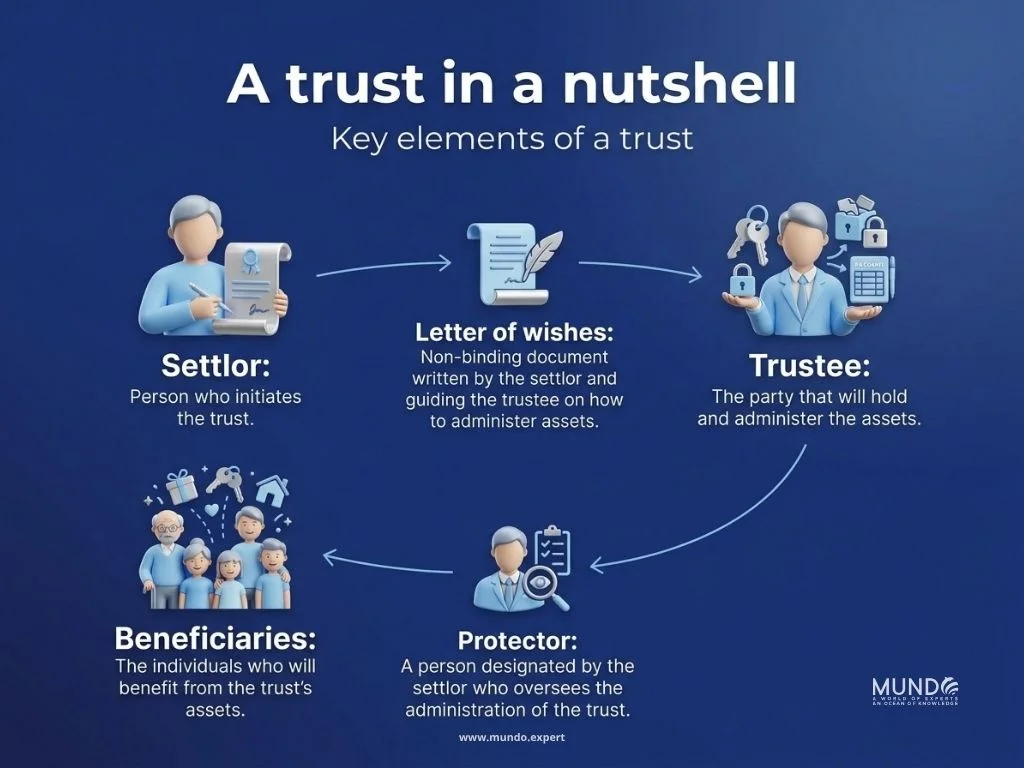
A trust in a nutshell
- Settlor: Person who initiates the trust. He or she chooses to start a trust to protect assets for the benefit of family or loved ones.
- Trustee: The party that will hold and administer the assets (it can be a natural or legal person)
- Beneficiaries: The individuals who will benefit from the trust’s assets. Ways of distribution and timeframes are decided by the settlor and reflected in the deed.
- Protector: A person designated by the settlor who oversees the administration of the trust and holds certain powers according to the deed. Appointing a protector is optional.
- Letter of wishes: non-binding document written by the settlor and guiding the trustee on how to administer assets and key decisions.
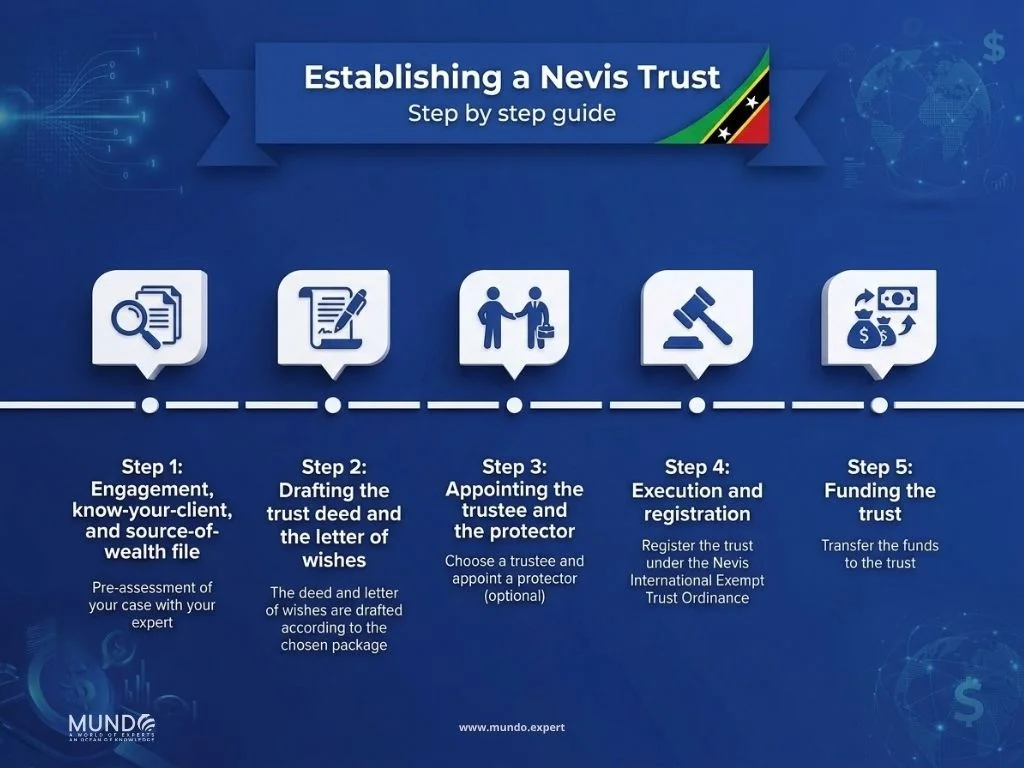
The formation process step by step
Step 1: engagement, know-your-client and source-of-wealth file
During a consultation with the Mundo experts, the appointed professional will review the case and establish the best path for the individual's or family's case. Mundo will issue an invoice, and once the legal fees are paid, we will send a form and an AML questionnaire. Then the client sends the documents, thus starting the due diligence process.
Step 2: drafting the trust deed and the letter of wishes
If the client chooses the silver or golden package, our legal team drafts and revises the trust deed. The client may request a legal opinion from an independent lawyer, but this is charged separately (included in the silver and gold packages).
Step 3: appointing the trustee and the protector (if chosen)
We establish the trustee, who can be a private trustee or a member of the trustee bar of Nevis, although this is not specifically required. There can be other trustees as well (they would be co-trustees), as long as one of the trustees is registered in Nevis. At this stage, the family can appoint a protector, but this is optional.
Step 4: execution and registration under the Nevis International Exempt Trust Ordinance
Once the deed and trustee have been properly set up and chosen, the trust is registered under the Nevis International Exempt Trust Ordinance, which is the legal backbone of the Nevis trust.
Step 5: Initial funding
The final stage consists of transferring the assets, a move that cannot be skipped. The settlor must transfer accounts, real estate, company shares, or whatever asset they plan to protect under the trust; otherwise, the trust won't exist. Unlike a foundation, which is a legal entity (like a company) and is registered and constituted as such, the trust is an agreement. Therefore, the trust doesn’t exist if it doesn’t have assets.
Realistic timeline from engagement to a fully funded trust
The process of Nevis trust formation varies greatly from case to case. Trusts are a tailored-made, legal tool and, unlike companies, they require a specific set of documents and occasionally an extra requirement by the registry. With trusts, the process depends on how long it takes for the client to gather the documents and how long it takes them to draft the deed. It also depends on the complexity of the case.
Protecting two apartments is not the same as several accounts in different countries, precious metals, company shares, or dividends. Mundo experts have had trusts set up in 2 weeks and others in as long as one year.
Putting your trust in the right hands: Choosing a trustee
Licensed corporate trustee against an individual: why most people choose the corporate trustee
Although the jurisdiction of Nevis is quite flexible when it comes to choosing a trustee, this decision is still a vital one. There can be foreign trustees in Nevis as long as the main trustee is based on the island. Although technically anyone can be a trustee, even a natural person, it's better to engage with licensed trustees that have experience in handling these structures.
There are sensitive moments, like keeping accounting records in Nevis, issuing reports for the IRS (US settlor), or maintaining the parties’ information up to date. All these steps are mandatory by law and are better when handled by professionals.
Establish your Nevis trust with Mundo
Contact our experts and book a consultation to establish your goals and analyze your needs.
The role of the protector
Powers of a protector: what they can and cannot do
The protector is a fourth party, usually a person. They don't necessarily have to be professionals, but the family's accountant, a company, a lawyer, or someone the family trusts. The protector will have a key role, adding an extra layer of protection because they have veto power over some decisions. Their specific powers depend on the trust deed; in general, they can change beneficiaries, appoint or remove a trustee, or make changes to the deed.
When a protector strengthens the structure and when it weakens it
The protector's role is key in cases with a complex asset base or many beneficiaries, especially if there are disagreements within the family. They become quite effective when it comes to controlling the trustee. On the other hand, this extra control can increase bureaucracy unnecessarily and prevent the trustee from efficiently handling the assets. If the protector is close to the family, there is a risk of bias. All in all, this can fuel disputes or create administrative friction.
According to recent amendments, the protector has the authority to direct the trustee and the power to approve distributions.
Trusts and numbers: How much does it cost to set up a Nevis trust?
Formation costs in the first year
Settlors will have to pay government fees and legal fees in the first year and subsequently, in the following years, for as long as the trust exists. The first year requires the standard government fees for structure registration, a registered agent, and a registered address, for both the trust registration and the registration of a private Trust Company. Besides, other costs should be factored in, like courier services, document issuance, accounting, opening bank accounts, and registering an LLC.
Mundo has designed three packages that include different services and are aimed at different needs. The bronze package is for the most experienced ones who are comfortable enough to handle several aspects by themselves, while the upgraded packages include more services. These are geared either for the least experienced ones or families who prefer to delegate.
Annual trustee costs and government fees
During the following years, settlors must pay annual renewal fees for the registered agent and the address of the trust, the PTC, and the LLC. Each of the structures requires its own annual fees and maintenance.
Ongoing administration
Records, resolutions and what the trustee must maintain
The trust is subject to AML and CFT regulations, according to which the main information of all the involved parties must be maintained in Nevis. The registered agent is responsible for keeping information about the beneficial owners, settlor, trustees, protectors, and beneficiaries. All this information must be accurate and constantly updated.
Reporting obligations in the settlor's home country
The concept of a trust as an instrument to hide money from the government is old-fashioned and misleading. Settlors and beneficiaries must understand that forming a trust doesn't exempt them from their responsibilities in their home countries or wherever they may have tax residency. Before the Nevis trust formation process, each party must consult with accountants and tax experts in every involved jurisdiction.
Reporting for US citizens
A foreign trust should never be seen as a way to escape U.S. tax, as there is no legal framework that supports such a move. According to the IRS, the owner of the trust pays taxes on the income of the said trust. Thus, they must receive a Foreign Grantor Trust Owner Statement (Form 3520-A, pages 3 and 4), a report that must include the income of the trust so that the owner can file income tax.
Regarding beneficiaries, in general, they will report the distributable net income, depending on whether the trust is a grantor or non-grantor trust. In this case, the beneficiary should receive a Foreign Grantor Trust Beneficiary Statement or a Foreign Non-Grantor Trust Beneficiary Statement, depending on the case.
The IRS website indicates that they should look for Form 3520 for more information about reporting distributions from foreign trusts. Nevertheless, we can't stress this enough: financial matters are complex per se, and even more so when a trust is involved and located overseas. Settlors, protectors, and beneficiaries should consult with U.S. tax experts specialized in the subject.
Disclaimer: the above information was taken from information published on official sources at the time of writing. Mundo doesn’t provide tax advice and is not responsible for the reader's actions regarding taxation. Each party involved in a trust must consult with a tax expert.
What causes a well-formed trust to fail
The Nevis trust is an almighty asset protection structure, backed by solid legislation and many advantageous features. Nevertheless, it's important to understand that its main reason for existing is separating ownership of the assets from the original owner. If a claimant's lawyer can prove otherwise, they can deem the trust a sham and seize the assets. Therefore, any indicator that may lead to thinking that the settlor still has some control will weaken the trust.
Disclaimer: The information shared in this article is provided for general knowledge purposes and does not constitute legal advice. These legal aspects and time frames may be inaccurate or outdated at the time of reading, so always consult with professionals before establishing a trust.
Nevis trust formation with Mundo: who we are
We are a team specializing in different services and tools for the international investor. A trust is a must in any financial strategy because it aims to protect a family's key assets. Our experts have ample experience and strategic connections on the island of Nevis, and thus can help you establish a trust safely and efficiently.
Furthermore, our ample knowledge about corporate services gives us the possibility to help you combine different tools for better results, like a trust and a Nevis LLC.
International investors should never forget that a financial plan has many aspects to cover: we can help you obtain second citizenship or second residency, open companies, bank accounts, and buy real estate in Panama. Contact our experts and let's discuss your Nevis trust or any other service that might interest you.
Still have doubts?
Book a consultation and find out more about Nevis trusts and how you can best implement them.