Why Panama City remains the region's connecting point
Today, we go back to the benefits of living in Panama, now with an orientation towards doing business. The country, especially the capital, Panama City, has become a hub for business and commerce in Central America and the region.
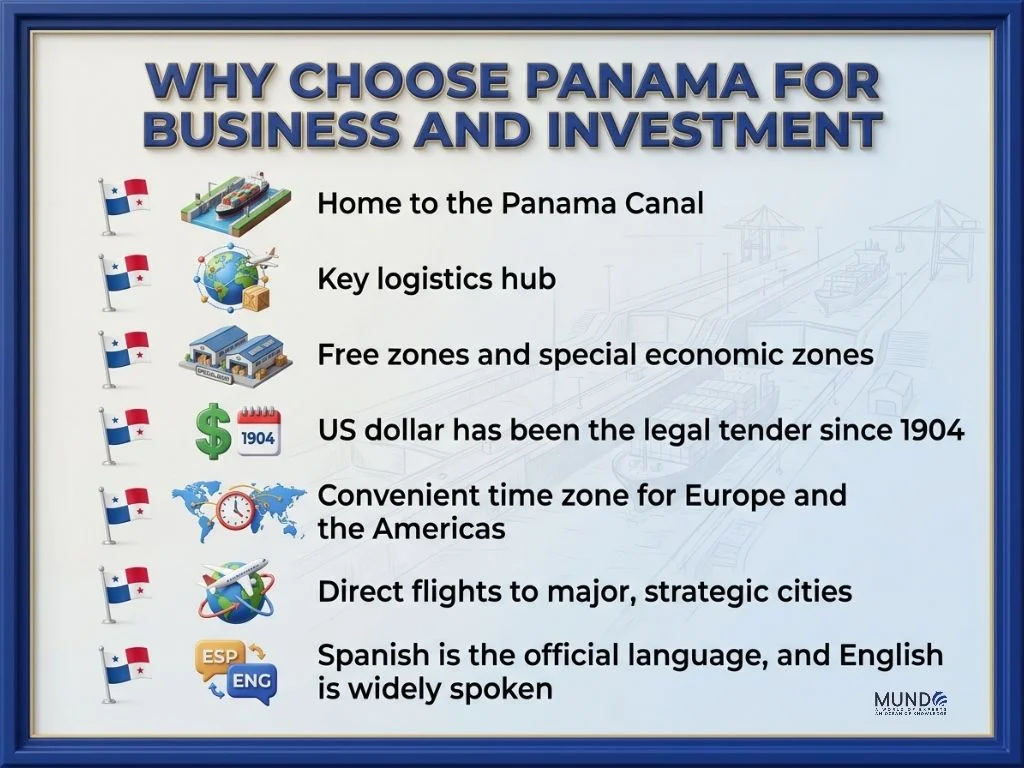
Advantages like a dollarized economy, the existence of the Panama Canal, and smart government policies position Panama as an epicenter of commerce, real estate development, and expat activity.
Today we introduce a guide for those who are contemplating doing business in Panama City.
Panama City as a business hub
- US dollar as legal tender
- Financial incentives and special economic zones
- The Colon Free Zone is the largest in the Western Hemisphere
- Excellent relocation hub thanks to a supreme lifestyle and several residency visas
- Advanced financial center and real estate sector
- Plenty of office rental space available
- One of the most spoken languages in the world (Spanish)
The canal, logistics, and what that means beyond shipping
Panama cannot be separated from the Panama Canal, one of the greatest engineering achievements of the 20th century. The country has grown with the canal (and thanks to it) since construction started in 1881 and since its inauguration in 1914.
For most of its lifetime, the canal was administered by the United States, so when Panama gained full control in 1999, a new era began for the isthmus. The results were visible in just a decade, during which Panama City became a thriving capital, an ideal place for relocation and expat living, and a destination with a vibrant business culture.
Extensive commercial activity attracts businesses, foreign professionals, and companies, which helps the whole sector thrive as a financial center.
The US dollar as legal tender and its practical benefits
Many choose the option of doing business in Panama City for the convenience of its currency, as the country uses the US dollar as legal tender. Most importantly, this isn't a fleeting trend or one government's whim: it is rooted in the country's history.
Panama adopted the US dollar in 1904, a year after it was separated from Colombia. This is a statement in and of itself: adopting the US dollar isn’t a fashion, but a decision that has been maintained for over a century.
Panama's dollarized economy brings enormous benefits, starting with stability. Companies and businesspeople don’t have to worry about issues that have historically struck other Latin American countries: hyperinflation and volatility.
This turns Panama into a rare oasis in the heart of the Americas. Adopting the US dollar also facilitates international wires and reduces currency exchange fees, which benefits areas like real estate, commerce, and banking.
Time zone and reach into North and South America
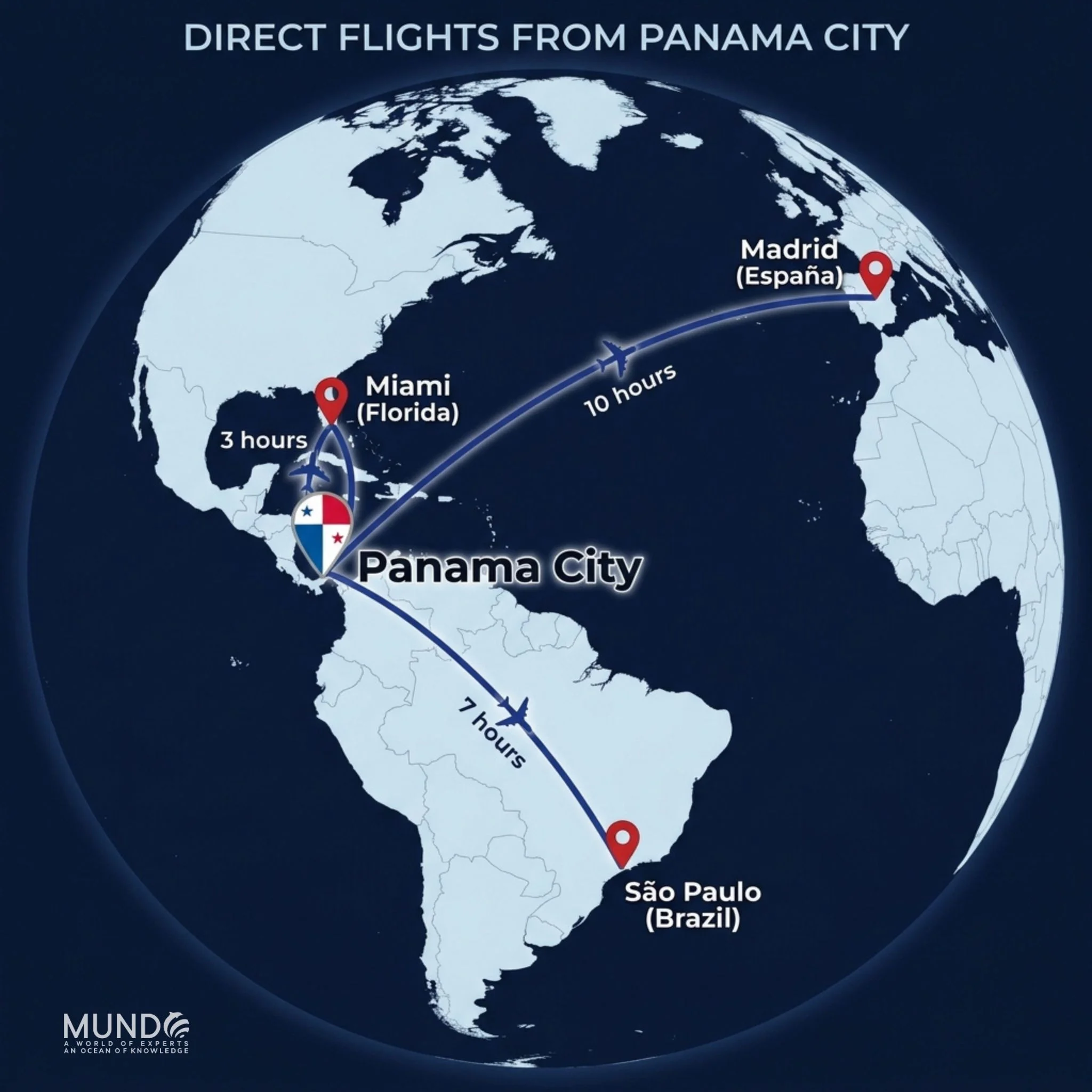
Panama has arguably one of the best positions in the Western Hemisphere, being accessible from key capitals like Buenos Aires, Bogota, Caracas, and Mexico City, and key urban centers like Sao Paulo, New York, Chicago, and Miami. Panama is a holiday destination in and of itself and is close to many others like Costa Rica, the Riviera Maya, Cuba, the Dominican Republic, Jamaica, and the Bahamas.
Quite often, proximity is not as relevant as direct flights, which make travel and connections more accessible, especially when travelling to distant locations. From Tocumen International Airport (PTY), there are direct flights to Miami, Houston, Atlanta, and Toronto (North America), Sao Paulo, Lima, and Santiago (South America), and Amsterdam, Paris, Madrid, and Istanbul (Europe and Eurasia).
Panama City’s connectivity: Direct flights to key sites
- Miami (North America)
- Houston (North America)
- Atlanta (North America)
- Toronto (North America)
- Mexico City (North America)
- San Jose (Central America)
- Bogota (South America)
- Lima (South America)
- Sao Paulo (South America)
- Santiago de Chile (South America)
- Buenos Aires (South America)
- Rosario (South America)
- Paris (Europe)
- Madrid (Europe)
- Amsterdam (Europe)
- Istanbul (Europe and Asia)
Panama’s location also makes it ideal for remote workers and businesses with cross-border teams. In short, for everyone who needs to hold frequent online conferences and meetings or maintain constant communication with providers or colleagues across the world.
Panama City observes GMT -5, which means it shares the same time zone with New York during the winter (when New York uses Eastern Standard Time). Thus, Panama is 3 hours ahead of LA, 2 hours behind Buenos Aires, 7 hours behind Madrid, 8 hours behind Moscow, 9 hours behind Dubai, 13 hours behind Shanghai, 14 hours behind Tokyo, and 15-16 hours behind Sidney.
As you can see from the paragraph above, Panama's time zone is ideal for service providers and businesses with clients in the Americas and Europe. The time frame between 8 and 11 am in Panama is perfect for holding meetings with any European city and even Moscow. Moreover, if they want to have a call with a provider in Sidney, they can hold it around 3 pm in Panama, as it will be morning time in Oceania.
*Remember that time frames may vary according to changes in every country or city; therefore, the above information must be confirmed every time.
Discuss your plans with a specialist.
Contact our experts to discuss different opportunities in Panama from company incorporation to residency.
Language, pace and business culture
How far can English carry you and where the magic stops
Even though Spanish is Panama’s official language, English is widely spoken. The Central American nation has always had close connections with the United States, mainly thanks to the construction and administration of the Canal. This, plus the cosmopolitan nature and the active tourist sector, drives people to learn English.
You'd be surprised at how far you can get doing business in Panama City speaking only English; nevertheless, it's imperative to rely on a trusted native speaker. A team member, a partner, or an employee who knows the local language will be necessary when reading and drafting documents or when attending business meetings, as not everyone will necessarily speak English there.
Most importantly, they can help you understand the culture, habits, and etiquette, and help you avoid embarrassing mistakes, like bringing up sensitive topics related to the country's history and politics.
Even though English can take you quite far, there is one clear and unavoidable limit: legal documents. Being in a Spanish-speaking nation, all contracts, foundation charts, agreements, and tax filings will be in Spanish. In this sense, it's always advisable to rely on a native speaker, preferably a lawyer.
Depending on your line of business, you may even want to hire a bilingual Panamanian lawyer because translation of legal documents goes beyond grammar and vocabulary. Only duly trained professionals will be able to understand the nuances of civil law, of which English-speaking businesspeople know little to nothing about.
Attitudes to deadlines and how to work with them
All foreigners doing business in Panama City know at least one word in Spanish. This word is “mañana”. It means “tomorrow”. “Mañana” reflects a trend in Panamanian business culture that is better to know in advance.
Panamanians have, in general, a more laid-back approach to daily tasks and responsibilities. Anglo-Saxon punctuality is not observed there, and it is perfectly natural to be a few minutes to a few hours late for social gatherings. As for business meetings, they are quite on time, but don’t expect perfect punctuality.
Somewhere down the road, you may need a technician to fix the air conditioner or a plumber to check the office faucets; if they tell you “mañana”, don't be surprised if they come three or four days later.
Formality, hierarchy and correspondence
Interestingly, Panama observes a strict dress code for offices and government entities. It's not possible to enter the Ministry of Labor or the Migrations office (to name a few) with informal wear. Women should not wear tank tops or flip-flops, and men shouldn't wear shorts or sandals. For business environments, men and women are expected to wear suits of traditional colors and cuts (blue, black, or grey), and men are expected to wear a tie.
How to get your mail in Panama
A fact that puzzles foreigners during their few weeks is the absence of addresses in the way we are used to in Europe or the US.
Finding such an advanced city with no door-to-door postal service might be odd, but this is the result of several factors. Firstly, the lack of formal street names and numbers for the houses makes standard mail delivery impossible. Secondly, the city grew faster than it could develop an effective postal structure.
For commuting, Panamanian citizens and residents rely on widely known landmarks and spots, like large supermarkets, malls, gas stations, churches, and so on. When it comes to international packages or orders from e-commerce stores, people rent private PO boxes.
What to watch out for: Mistakes newcomers often make
Over-relying on addresses
Following the above point, one of the very first mistakes people make is trying to find a building by its address. Accustomed to a whole different approach, many foreigners try to find offices by the addresses they have seen written on paper. This is impossible unless they know how to get there and what landmarks are nearby.
The first few times, web mapping platforms (like Google Maps) are a vital tool before one learns his/her way across town.
Estimate time based on distance (not traffic)
Rush hour in Panama is nothing like what you experience in Miami, New York, or Chicago; it is ten times worse. Panama is one of the oldest cities in the Americas, which means that it was built before the Laws of the Indies, that is, before a grid structure was mandated across all colonial settlements.
Downtown, thus, presents a chaotic layout, with labyrinthine small streets and narrow main avenues with no room for enhancement. At the same time, this is where the main spots are: malls, supermarkets, offices, tourist districts, etc.
Any route that you would cover in 10 minutes at 11 pm can take you two hours at 5 in the afternoon. Business owners should consider this if they have an appointment or meeting around these times.
Don’t start working without a permit
At the risk of sounding obvious, it's imperative to clarify that working or doing business in Panama without a work permit is illegal. Foreigners can apply for a work permit at the MITRADEL (Ministry of Labor) after obtaining Panama residency, which is generally granted in 6-8 months, depending on the chosen visa and the peculiarities of the case.
All in all, it might take a year before the person is able to work legally, yet this doesn’t have to be idle time. On the contrary, it might be the perfect opportunity to settle down, study the business sector, foster business partnerships, and pick up on how things work on a day-to-day basis.
What can Mundo do for you?
Mundo is a global service provider focusing on the global citizen and international investor. If you're planning on doing business in Panama City, turn to us to establish your company, register a foundation, or open bank accounts. If this interest comes with relocation plans or simply a second residency, we can help you apply for any of the visas available.
With our in-house lawyer and our experts having several years of experience, we can help you fulfill your Panama-oriented goals safely and efficiently. We will be happy to help you with other jurisdictions too, like citizenship by investment in São Tomé and Príncipe, Vanuatu, Saint Kitts and Nevis, Grenada, and St. Lucia. Contact us and let's discuss the best approach.
Book a private consultation
Contact our team, tell us about your case, and let's outline the most suitable strategy.
Frequently Asked Questions
What makes Panama City attractive as a business base?
Panama City, Panama, is a business and commercial hub thanks to several factors: the Panama Canal, the free zones and special economic zones, a dollarized economy, and government incentives that facilitate commerce, trade, and business.
Is Spanish necessary to do business in Panama?
It is not necessary to speak Spanish in order to do business in Panama, but it is important to have a native Spanish speaker close, like a partner, an employee, or an advisor, especially when it comes to handling contracts and legal documents.
Where in Panama City is professional life concentrated?
All professional life in Panama City is mainly concentrated downtown, from Marbella to Obarrio and Via España, including coastal districts like Punta Pacifica, and areas away from downtown like Albrook or Costa del Este. Nevertheless, the main concentration of offices and banks is in Calle 50, which is considered the banking district.
Which industries are most open to foreign entrants?
Foreigners in Panama are most likely to work in activities related to the Panama Canal, like shipping, freight forwarding, and supply chain management. Also, many foreigners are dedicated to investment, especially in the real estate sector.
What professions are restricted for foreigners?
In Panama, some professions and activities can be conducted or practiced only by Panamanian citizens. In general terms, these are medicine and veterinary medicine, running retail businesses, engineering and architecture, and practicing law.
Do I have to pay tax if I run a business in Panama?
Yes. Panamanian businesses and individuals pay taxes in Panama on all the income derived within the territory. Companies or individuals that have verified Panama tax residency are exempt from paying taxes on all their assets outside of Panama.
What difference does the US dollar as legal tender make in practice?
Doing business in Panama is quite convenient for international corporations because they don't have to pay currency exchange rates; they can transfer funds easily internationally, and their asset base is not subject to volatility or excessive inflation.
Can Panama City be a good base to work remotely with US clients?
Yes. Panama City is ideal for working remotely with US clients because of its time zone, paired with New York during the winter and three hours ahead of the Pacific coast. Furthermore, Panama's dollarized economy eliminates the need for currency conversion and exchange rates.
What mistakes do newcomers most often make in Panamanian business settings?
Foreign businesspeople can misinterpret Panamanian politeness for a tacit agreement. Another common mistake is expecting rigid timelines in a country that inherently maintains a slower pace when it comes to decision-making and a flexible approach to daily tasks.
Can I work as a doctor or a lawyer in Panama if I acquire permanent residency?
No. Some professions, like medicine, law, retail businesses, architecture, and engineering, are exclusive to Panamanian citizens. Even if they obtain permanent residency, foreigners can't practice these professions.