Preparing yourself for Panama: main considerations when relocating with family
Relocating requires thorough planning, for individuals and especially for families. From a financial point of view, planning encompasses real estate, investing in securities, or even establishing an operating company. Yet when it comes to living in Panama, the landscape widens and includes several other aspects related to daily life, like health insurance, cost of living, buying or renting in Panama, utilities, available schools, tuition fees, and so on. Here is a guide for the expat family that is looking at Panama as a place to settle, whether in the mid- or long-term.
Main advantages of Panama for the expat family
- Plenty of international schools
- Bilingual education in some schools
- School calendar like in the US (in some schools)
- Best-in-class healthcare
- Low cost of living
- Safe environment
- Great lifestyle
Finding an international school in Panama: calendars, language adjustment, and types of institutions
School types: international, bilingual, local private
Panama is foreign-oriented at its core, as shown in its approach to foreign ownership and flexible residency visas. With about 11% of its population from abroad, the rise of international schools is not surprising. What’s more, in the past decade the isthmus’s foreign population increased by 150%.
Curricula, languages, and mandatory subjects in Spanish
International schools in Panama are private schools whose curricula differ from the local study plans. Most of them follow the American curriculum, the British curriculum, or the International Baccalaureate. Many of these institutions are, in addition, bilingual, offering tuition in Spanish and a foreign language, with German, French, and English being the most common.
Children attending international schools will find that all lessons are taught in the foreign language by native speaking teachers. Besides, there is a set of subjects taught in Spanish. By law, all schools must teach a block of subjects in the country’s official language, like Spanish, Panamanian history, geography, civil system, and social studies.
All in all, this combination gives expat families the chance to educate their children under the curricula of their own countries, yet adds a local component thanks to the mandatory lessons in Spanish, and a global perspective thanks to the cosmopolitan environment.
How to move to Panama legally
Do you like what you read about Panama? Contact our team and find out what residency progam suits you best
Moving to Panama with children – important aspects: Language adjustment and socialization
The brighter side of international schools is that children don't necessarily have to excel in Spanish from the start: they’ll have a chance to become fluent as they study at school. For children coming from the US or the UK, international schools in Panama constitute an environment where they can continue to hear their own language while they transition into their life as young expats. If conversations during recess are mainly in Spanish and children feel left out, parents may choose to reinforce lessons with private teachers outside of school.
It's worth noting that expats in Panama tend to find other expats. They quickly find their own, that is, communities of people sharing the same background, whether in nationality, language, religion, or geographical proximity.
Thus, the family’s social life can develop seamlessly without mastering the language of Cervantes. Nevertheless, if the objective is to stay in Panama for a long time, it’s important that the youngest ones properly learn Spanish, as it will surely become handy sooner or later.
Important aspects of relocating to Panama: Healthcare, private clinics, public system, insurance
How the system works: public and private sector
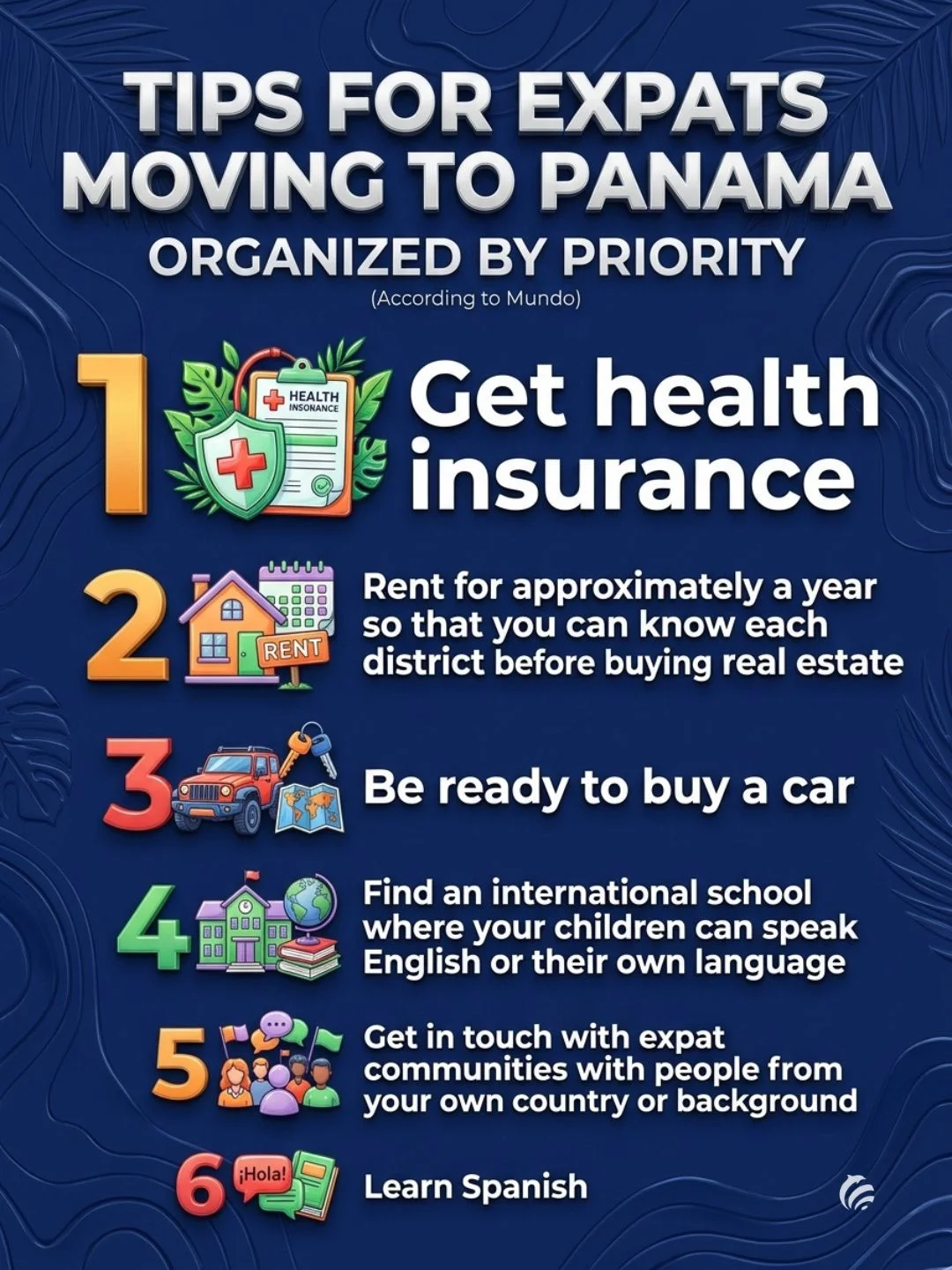
In Panama, the public health sector is quite accessible and inexpensive, yet it poses longer waiting times. This is why most families relocating to Panama choose private clinics for their appointments, follow-ups, and procedures.
For this reason, they buy health insurance so that each visit to the doctor is less expensive or fully covered, depending on their insurance contract.
International coverage versus local health insurance for the expat family
Many expats moving to Panama with children wonder whether to maintain their international coverage or hire local insurance. There is no one-size-fits-all answer, but we can analyze both alternatives carefully to make an informed decision.
International insurance is usually more expensive, and it has longer waiting periods for certain benefits. This alone puts it behind the local options. Furthermore, by getting health insurance in Panama, they'll have access to more clinics, and processes will be more straightforward because all doctors, equipment, prescriptions, etc., will function within the same framework.
The following formula might help tilt the scale in favor of one or the other:
If the family maintains an international lifestyle (traveling often, spending extended seasons in different countries), it might be worth paying higher premiums for international insurance.
On the other hand, if the expat family spends most of their time in Panama, the obvious, easiest, and most cost-effective alternative is Panamanian health insurance. When going abroad (to visit relatives, for a wedding, or vacations), they can buy a specific travel assistance package for those specific dates only.
Relocating to Panama – Where to live?
Renting vs buying
Whether to rent or buy right away fully depends on the family's needs, preferences, and possibilities. Ideally, the family should rent for at least a year so that they can get to know the city. This way, they will purchase in a place they actually like, and that truly fits their lifestyle.
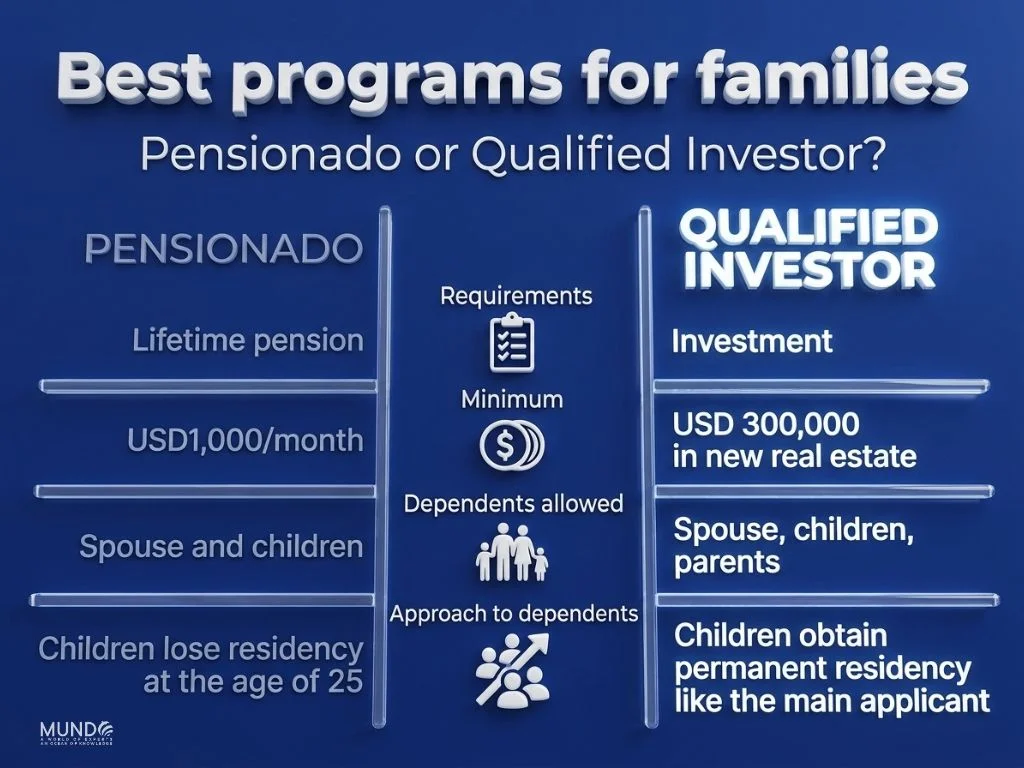
Nevertheless, many foreigners buy real estate to qualify for a residency permit. This is possible through several migration programs, like the Friendly Nations or Qualified Investor. If they prefer to rent before deciding on a specific development, they can choose to obtain residency through other options, as you can see from the following table.
Alternatives to real estate within Panama residency programs
|
Minimum investment |
Program |
What it grants |
|
|
Fixed-term deposit |
USD 200,000 |
Friendly Nations (only for qualifying nations) |
2-year residency |
|
Fixed-term deposit |
USD 750,000 |
Qualified Investor |
Permanent |
|
Fixed-term deposit |
USD 300,000 |
Self-solvency (not nationality restricted) |
2-year residency |
|
Stock market |
USD 500,000 |
Qualified Investor |
Permanent |
|
Teak land project |
USD 100,000 |
Reforestation |
2-year residency |
|
Teak land project |
USD350,000 |
Reforestation |
Permanent |
Best districts for a family
In general, residential areas with ample green spaces, gated communities, and secluded locations are considered ideal for families with young kids, yet not all families have the same preferences. Some would rather live in places where they can have an active cultural lifestyle, where they can be close to the office, theatres, universities, cultural venues, festivals, restaurants, pubs, and city landmarks. This is why we have divided this section into two subsections, considering the best neighborhoods for each category.
Best districts for a family - Uptown
Costa del Este
This is the ideal neighborhood for expats moving to Panama with children, as it offers the best of two worlds. Although it's mainly residential, it has plenty of commercial and business activity, restaurants, malls, stores, clinics, and offices. Its best advantage when compared to downtown is that it was specifically built to be pedestrian-friendly.
Clayton
Formerly Fort Clayton, this was a U.S. Army base before the administration of the Canal was ceded to Panama. Now it's a lovely residential neighborhood that has inherited the typical American layout with flat houses, large gardens, ample sidewalks, and leafy trees.
Santa Maria
An easy way to describe Santa Maria is that it’s Costa del Este’s more residential version. It’s 5-10 minutes from Costa del Este and 15 minutes from downtown. Some of Santa Maria’s most outstanding features are its golf course, green outdoor areas, and overall laid-back, hushed atmosphere.
Best districts for a family - Downtown
Marbella
Living in Marbella, families will have beautiful landmarks and plenty of urban activities within walking distance. Being in the heart of the city, it’s close to Calle Uruguay, the Cinta Costera, Calle 50, and Via España.
Obarrio
This is one of the most residential neighborhoods in the city center. Adjacent to El Canrejo, it's at a close distance from Calle 50, Via Transístmica, and Plaza Edison, while maintaining a residential feel.
Punta pacifica
One of the most upscale neighborhoods in Panama City, Punta Pacifica is characterized by glassy skyscrapers. It is residential in the sense that there is little commercial activity, but it's not flat like Clayton. On the contrary, it boasts elegant and modern towers. Panama City’s famous skyline is actually in large part Punta Pacífica, seen from the Cinta Costera or Mercado de Mariscos.
Another advantage worth mentioning is that it's home to two of the most prestigious clinics: Panama Clinic and Pacifica Salud Hospital Punta Pacífica. Besides being convenient for the family, this adds rental value thanks to the area’s medical tourism potential.
Commuting and transportation: Can you live without a car in Panama?
The simple answer is no. Panama is a very old city (it was one of the first Spanish colonial settlements on the Pacific Coast); hence, it grew as it came. The city center lacks an organized grid system; instead, it consists of several labyrinthine streets that can’t cope with the dense traffic of a modern capital.
Those who have ventured into the colonial quarter have surely noticed that Casco Viejo has a completely different layout. This is because it was built later on, after the original settlement was burned by pirate Henry Morgan. By that time, the Laws of the Indies were already in effect.
In our days, this means that most of Panama City is practically unwalkable, or extremely uncomfortable for pedestrians. As for public transportation, it is far from being as developed as in Europe or the US, except for the metro, which is still relatively new.
Panama’s metro system was inaugurated in 2014, while London (1863), Buenos Aires (1913), Moscow (1935), to name a few, are several decades ahead. In such a scenario, it’s very hard to move around comfortably without a car; that’s why it’s not unusual to have at least two vehicles per family.
Disclaimer. The details in this article are provided for general information purposes only, and they may be inaccurate or outdated at the time of reading. This article doesn't constitute legal advice. Every individual who decides to move abroad is responsible for conducting research, consulting with certified experts, and analyzing the pros and cons of such a move.
How can Mundo help relocating families
Our field of expertise is not relocation in itself, but processing what makes relocation possible: legal residency. With a team of highly knowledgeable advisors and experts, and with an in-house lawyer, we can guide expats and their dependents to apply for Panama residency safely and straightforwardly.
Since we have an office in Panama City and an on-site team, we're quite familiar with the country's processes, peculiarities, and culture. Furthermore, our team speaks different languages; thus, we can cater to clients from various backgrounds.
If relocating to Panama with your family falls within your short- or mid-term plans, talk to us and let's discuss the most suitable program and strategy. Besides, we can provide corporate, trustee, and banking services and assist you with buying real estate in the country. Contact us today and let's discuss your needs and preferences.
Apply for Panama residency
Talk to our experts and choose the most suitable route towards Panama relocation
Frequently asked questions
In what language do expat children study in Panama?
This depends on the chosen school. There are plenty of bilingual schools in Panama City and international schools working with US or UK curricula. In such institutions, lessons are imparted in the foreign language; however, some subjects must be taught in Spanish by law. This results in a rich, cosmopolitan landscape, ideal for children from globally minded families.
What are my chances of socialization if I don’t speak Spanish?
Many expats are able to socialize without the need to learn Spanish, except for a few basic words. There are plenty of expat communities in which people with similar backgrounds get together for parties, celebrations, national holidays, religious ceremonies, or good old social gatherings.
Is Panama's healthcare level good?
Yes. Panama's medical and healthcare standards are outstanding, with modern clinics and state-of-the-art equipment. Thanks to the cosmopolitan nature of the country, it's possible to find family doctors who speak English.
What districts in Panama City are best for families?
Families living in Panama usually choose places like Costa del Este or Santa Maria. Both are uptown districts that place the family in a residential environment near the city center. Costa del Este is known for having plenty of buildings, schools, stores, supermarkets, and walkable spaces, while Santa Maria is more residential, with fewer constructions, more outdoor spaces, and a golf course.
Is it necessary to have a car in Panama?
Expats should secure themselves at least a car (ideally two or three cars per family). Public transportation and city infrastructure are far from being as developed as in Europe or the US, which makes transportation without a car quite inconvenient.
Can we bring pets to Panama and what does it take?
Yes. The pet must comply with health requirements stipulated by law and must be kept in strict quarantine after arrival.