
What Law 546 of 2026 changed in Panama
One of the main updates we've seen in Panama this year is directly related to real estate: Law 546 of 2026. Through this law, passed on August 31st, 2026, the government eliminates the property transfer tax on the first USD 120,000. The benefit only applies if the property is new and if it's the first real estate the person or couple is buying.
By applying this measure, President Jose Raul Mulino takes one more step toward reaching his objective, which is to encourage the rise of new developments and benefit the construction industry.
ITBI or real property transfer tax: definition and details in Panama
Who must pay it and who really pays it
ITBI is short for Impuesto de Transferencia de Bienes Inmuebles (Tax on Transfer of Real Estate), and is paid when a property is bought/sold. By default, a real estate sale involves a transfer, as ownership must be passed on to the new owner or owners.
Even though this tax is the seller’s responsibility, it’s usually added to the final price, resulting in elevated costs. Indirectly, buyers might be paying for ITBI too.
ITBI, annual property tax, or capital gains tax?
Some actions in a person's life or business operations trigger taxation (selling stocks, selling a valuable work of art, earning money, receiving an inheritance, and so on). Transfer of real estate ownership falls into this category.
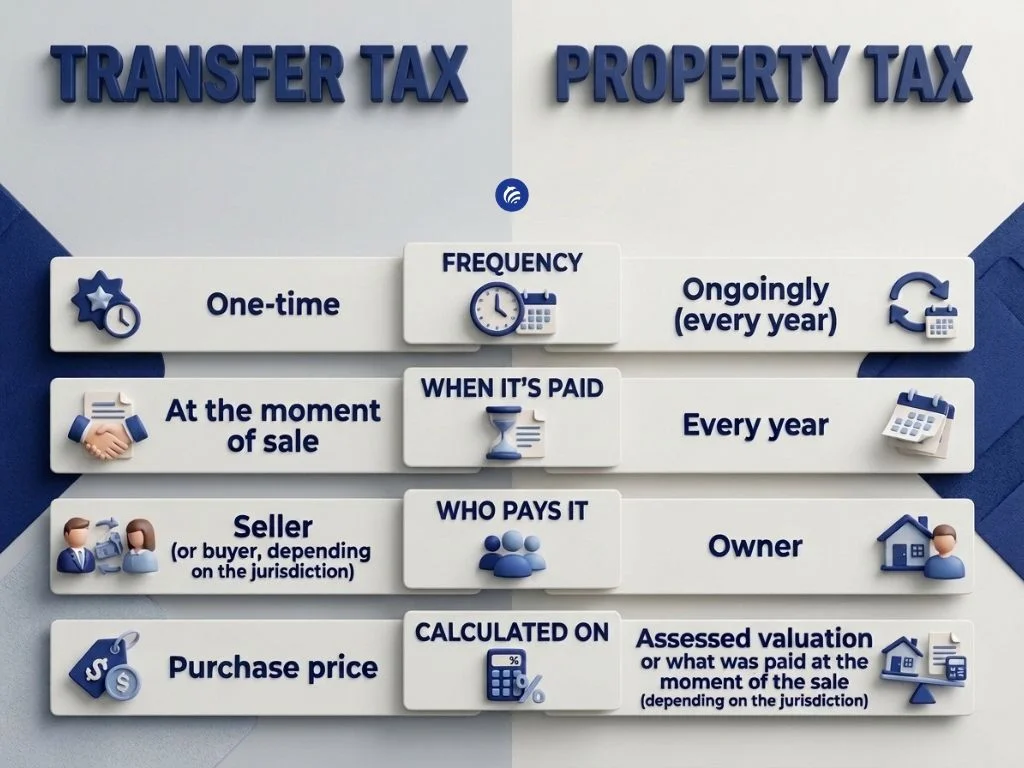
To understand the ITBI exemption and how it can impact your investment and portfolio, it's better to understand that this is but one of the many taxes involved. Moreover, taxes are applied beyond the purchase itself. Here are three types of taxation that are or can be connected to real estate.
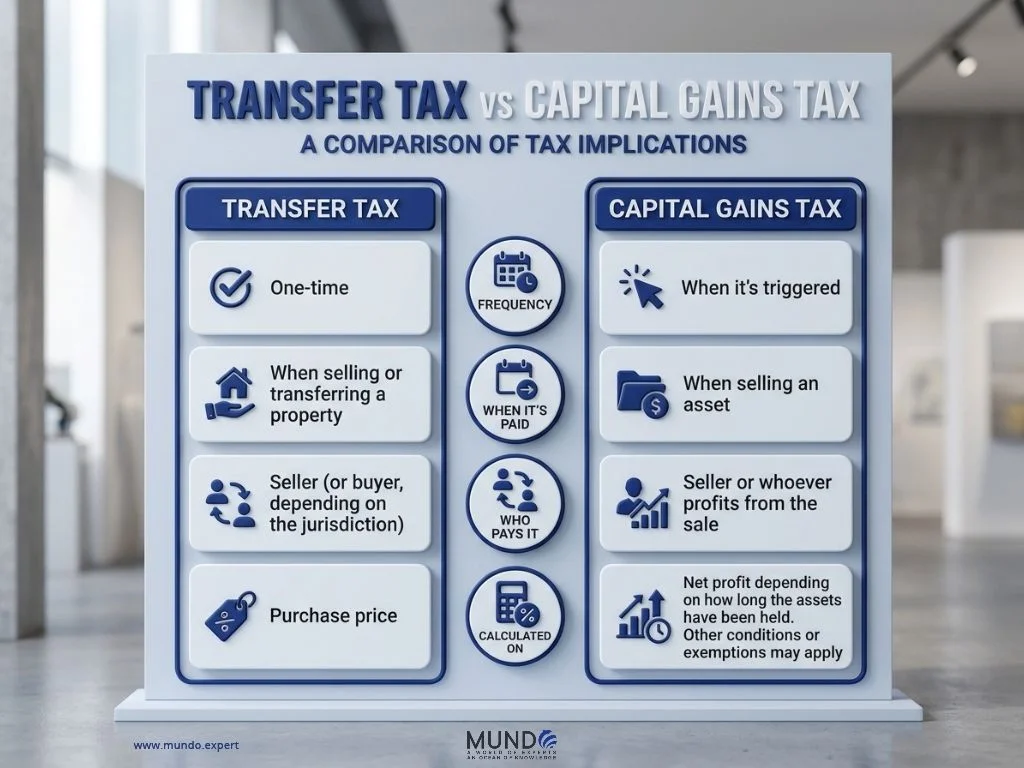
ITBI or real property transfer tax: as explained above, this is paid by the seller when transferring the real estate property to a new owner.
Property tax: property tax is not triggered by the purchase. Instead, it’s due ongoingly (every year) by anyone who owns real estate. In Panama, property tax is lower for the person's main residence, i.e., where they live, and higher for secondary homes or commercial real estate. For primary residences, property tax ranges from 0.5% to 0.7%, while for secondary property it ranges from 0.6% to 1%.
Capital gains tax: While it's also triggered by a real estate sale, capital gains tax is different at its core. Unlike transfer tax, capital gains tax is estimated on the net profit, not the property’s value (expenses and previous cost of the property must be deducted).
At the risk of oversimplifying a very complex matter, it helps to think of it this way: if a person sells a property for USD 150,000, but they bought it for USD 120,000, their profit is only USD 30,000. If they bought it for USD 90,000, their earnings would be larger.
Capital gains tax applies not only to real estate but also to any asset being sold, such as securities, crypto, precious metals, works of art, collectibles, and others.
What changes does Law 546 of 2026 bring: the ITBI exemption in Panama
The ITBI exemption: exempt value and ITBI charged on the excess
Law 546 of 2026 was passed on August 31st and stipulates an exemption from transfer tax on new real estate up to a USD 120,000 value. If the property is more expensive, different tax rates apply to the excess. Furthermore, said rates are reduced if the overall value doesn’t exceed USD 200,000
Panama transfer tax on new real estate 2026 (after Law 546)
|
Rates applied to the excess |
|
|
Up to USD 120,000 |
Exempt |
|
From USD 120,000 to USD 130,000 |
0.50% |
|
From USD 130,000 to USD 150,000 |
1.00% |
|
From USD 150,000 to USD 170,000 |
1.40% |
|
From USD 170,000 to USD 190,000 |
1.60% |
|
From USD 190,000 to USD 200,000* |
1.80% |
*Lower rates apply when property value doesn’t exceed USD 200,000
The ITBI exemption is not for everyone: under what conditions does it apply
New home and first purchase
President Mulino was very clear about Law 546 and its long-term purpose. The exemption applies under two specific conditions: the real estate must be newly built, and it must be the buyer's first real estate purchase. With this, the government encourages construction and makes it easier for middle-class families to buy their first homes.
The deadline measured from the occupancy permit
The said law stipulates that new real estate, established from the moment the new law became effective, can benefit from what's established on Article 4 of Law 106 of 1974, even when the occupancy permit was issued before that date, as long as the sale is made within the following 30 months from the date of issuance of the occupancy permit. All operations conducted before the law entered into practice will be governed by the dispositions that were in place at the moment of their occurrence.
What this means for a foreign buyer or Qualified Investor applicant
In practice, private buyers (local or foreign) and investors who are buying their first home in Panama will benefit from Law 546. It will help reduce the overall cost of the operation and encourage real estate purchases, specifically in the market of the newly-built.
Law 546 is in line with the recent amendments to the QI program
Also in 2026, the government announced a key update to the Qualified Investor Visa, whose most popular and accessible route is real estate. This amendment also favors the construction sector as it stipulates a lower minimum investment for buyers who apply for permanent residency through real estate.
For the sake of clarity, the minimum investment for new real estate didn’t change; instead, the threshold for resale property increased to USD 500,000.
Thus, the Qualified Investor under the new standards looks like this:
|
Minimum investment |
What changed and what didn’t |
|
|
New real estate |
USD 300,000 |
Same threshold |
|
Resale real estate |
USD 500,000 |
Changed |
|
Stock market |
USD 500,000 |
Same threshold |
|
Fixed-term deposit |
USD 750,000 |
Same threshold |
What this means for the real estate sector
Both measures, Law 546 of 2026, and the Qualified Investor amendment, aim at the same goal: fostering construction in Panama. They work in favor of a specific sector of the real estate industry: construction, thus encouraging the development of new projects, the creation of job positions, and stimulating economic activity.
Disclaimer: the information written in this article is provided for general knowledge only. Mundo doesn't provide tax advice; thus, everyone ordering a service from Mundo is responsible for their own tax compliance. This article doesn't constitute tax or legal advice. Before selling or buying real estate, always consult with certified professionals.
Why Mundo: how can we assist you
Mundo is an international service provider specializing in trusts, companies, banking, investment migration, and real estate. Hence, we can help you establish a strong presence in Panama, starting with acquiring real estate and applying for residency, and following with company incorporation and bank account opening, depending on your personal and business needs.
Whether choosing an isolated product or implementing several interconnected tools, we assist international businesspeople and global citizens. Furthermore, since we have a physical office in Panama, and since several of our team members (including our CEO) are based in Panama, we can provide effective guidance in all areas regarding this country. Write to us and let's discuss your Panama-related plans.
Buy real estate in Panama
Contact our team and talk to our real estate experts so that they can introduce you to the top projects in Panama City and the provinces.
Frequently asked questions
What does Law 546 of 2026 change in Panama?
Law 546 of 2026 eliminates the transfer tax on new real estate property when the buyer is acquiring his/her first home.
How much of a new home's value is exempt from ITBI under Law 546 in Panama?
Law 546 of Panama exempts transfer tax on the first USD 120,000, applying transfer tax to the excess when the property is more expensive.
Who pays ITBI in Panama, the buyer or the seller?
ITBI (transfer tax) in Panama is due by the seller.
Can the exemption of transfer tax through Law 546 be applied to resale properties?
No, Panama’s new Law 546 stipulates an exemption from transfer tax only on newly built real estate.
How is ITBI calculated on a home priced above the exempt tranche?
Properties whose value exceeds USD 120,000 must pay transfer tax, which is estimated on the excess. Rates range from 0.50% to 1.80%
How is ITBI different from Panama's annual property tax?
ITBI is triggered by a real estate transaction, and it’s paid only once (at the moment of the sale). On the other hand, property tax is paid annually for any real estate property (or properties) an individual or company may own.
When did Law 546 of 2026 take effect?
Law 546 of 2026 was passed on August 31st, 2026, and took effect on September 1st, 2026.