









































Challenging a Nevis Trust: Why Creditors Give Up Before Filing


Introduction: The Allure and Reality of Nevis Trusts
When discussing asset protection, there are several myths, marketing lines, and promotions; hence, it becomes difficult to understand the exact value of a given structure. However, there are certain factors that make this protection reliable and durable if the trust is properly established.
This article is dedicated to analyzing why Nevis has become the king of asset protection, helping families avoid creditor challenges: Nevis trust laws are geared for the utmost protection.
What Makes a Nevis Trust Different from Other Offshore Structures
When establishing a trust abroad, people’s heads turn to jurisdictions like Nevis, the Cook Islands, Belize, and the BVI. What do they have in common? They are all islands or small nations, and highly reliant on foreign investment to support their economies.
All their laws are drafted to benefit the investor and offer the friendliest conditions possible. So, what makes Nevis stand out among so many best-in-class, asset-protection jurisdictions?
The Creditor’s Perspective: Why the First Reaction Is Often to Walk Away
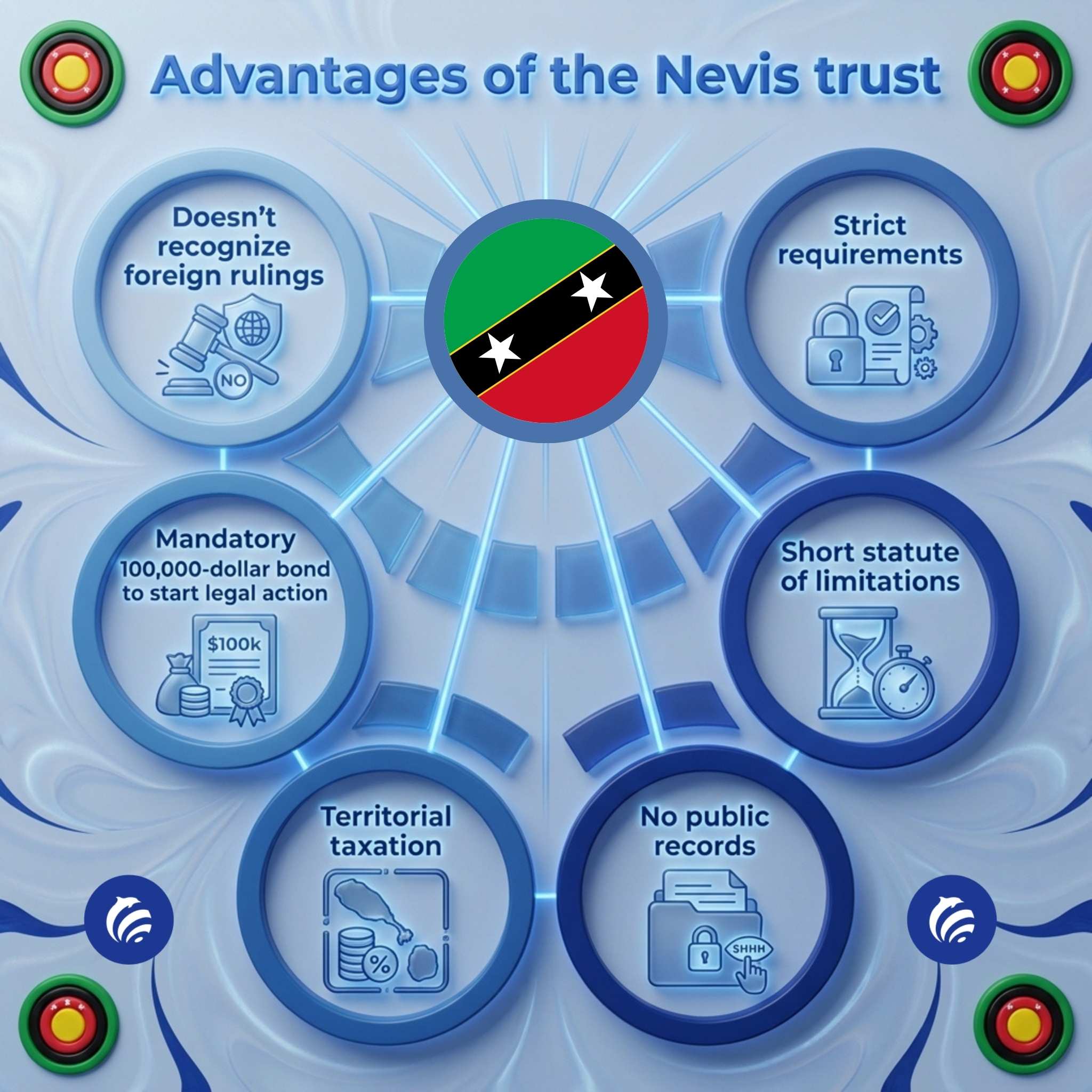
The core of the strategy is to discourage potential claimants or ill-intended players who may want to harm the family on purpose. Nevis laws stipulate a bond of $100,000 to even start legal action against the trust.
When a person or family has an activity that’s prone to lawsuits or liabilities, this strategy becomes relevant. Not everyone can spare $100,000 just like that, so malicious claimants or petitioners will think twice before proceeding.
Mandatory Local Counsel and Exclusive Nevisian Jurisdiction Requirements
The Nevis International Exempt Trust Ordinance, better known as NIETO, stipulates that foreign rulings can't be applied to intervene a trust in the jurisdiction of Nevis. Asset protection is strengthened by the fact that claimants are obliged to take legal action within the jurisdiction. These rules add an extra layer that will force creditors to act in a foreign jurisdiction where they have to rely on local, unknown professionals, pay higher fees, and shell out $100,000.
The “Beyond Reasonable Doubt” Standard for Fraudulent Transfer Claims
Claimants going after a trust have one goal in mind: proving that the trust doesn't exist or that it was deliberately created to avoid payment. There are several loopholes they can use to prove this, especially if the trust is not properly drafted.
Failing to transfer the assets is a major mistake, as this can be used to prove fraudulent intention. Unlike foundations, which are independent entities that can exist without assets, the trust is an agreement to administer another person's assets.
So, how can a trustee manage assets that were never transferred? Such an omission will surely leave the trust unprotected.
The Strict Statute of Limitations: One Year From Transfer, Two From Discovery
The statute of limitations establishes the window in which a creditor can start legal action. This window is vital in the asset protection strategy because when this period expires, the trust reaches its true potential.
In Nevis, there are two windows. If an asset is transferred to the trust after the creditor’s cause of action accrued, the claim can be brought in before the two years after the cause of action. If the assets were transferred before the 2nd year expiration, the creditor must start action within one year from the date the asset was settled or transferred to the trust.
These one-year and two-year windows are the only chance for a creditor to challenge the structure.
Financial and Procedural Deterrents
Adverse Cost Shifting: Why Losing Can Be Financially Catastrophic
To the above-mentioned $100,000 bond, adverse cost shifting adds yet another layer of protection. This rule stipulates that the losing party pays the counterpart’s legal fees. This financial risk often prevents frivolous claims or the so-called fishing expeditions.
Limited Discovery and the “Black Box” Nature of Trust Administration
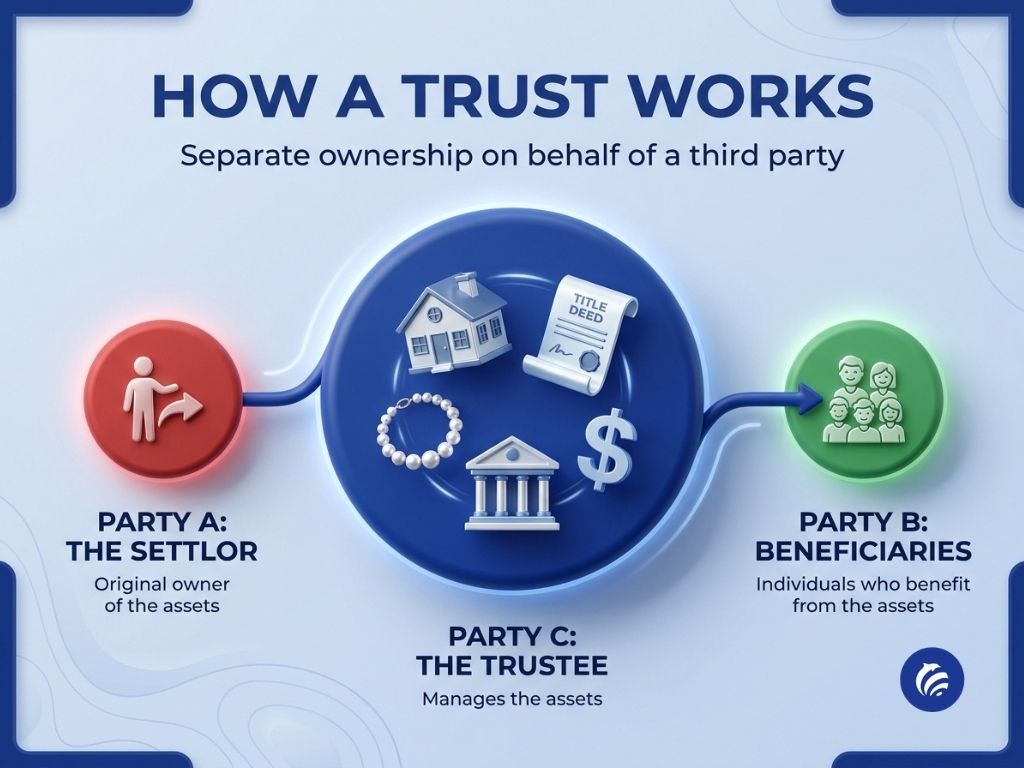
The essence of a trust lies in separating assets from the original owner. There's an individual or company that administers the assets of a certain party, let's call it A, to benefit another party, let's call it B.
Since the original owner has given up control over the assets, the trust can fall under a concept known as “fiduciary black box”. This represents a situation in which the activities, decisions, and reasons of the managers for distributing or managing assets are allegedly not fully transparent.
While trustees are required to provide accounting records, they are not always obliged to present a step-by-step decision-making process. These limitations have a purpose: they prevent harassment from the beneficiaries’ side.
On the other hand, the beneficiaries don’t have the right to ask for details if their concerns are well-founded. In short, beneficiaries must have a good reason to ask for the internal reporting procedures, which is not always easy or inexpensive.
Strategic Realities: Why Creditors Choose Not to File
Cost-Benefit Analysis: When Litigation Expenses Outweigh Recoverable Assets
Without a solid reason, challenging a Nevis trust is highly risky. Claimants will have to prove that the trust is fraudulent beyond a reasonable doubt.
Furthermore, this must be done within the first two years, or the trust becomes unbeatable.
Settlement Leverage: How the Threat of a Nevis Trust Drives Pre-Filing Compromises
Some lawyers recommend entering pre-filing compromises with the settlor. If the challenge is unsuccessful, the costs are astronomical, so sometimes they’d rather settle. In this sense, settlors are in a better position to negotiate, unless they want to settle for other reasons, as seen below.
Reputational and Opportunity Costs of Protracted Offshore Litigation
Protracted litigations cost more than money: they take time, and they raise questions. Settlors are concerned about the reputational costs of going through long litigations, which can become public knowledge or come to the attention of stakeholders or potential investors.
On the other hand, lengthy legal procedures lead to higher costs, demanding timing, and capital misallocation, forcing the cash flow to cover the legal fees rather than to be invested in research, development, or new acquisitions.
Advantages of the Nevis trust
Protection of assets
Since it's based on the principle of separating ownership, originated in England in the 12th century, a trust constitutes robust protection against potential threats.
If properly established, it's practically unbreachable, and it can hold a variety of assets from real estate to jewelry, works of art, companies, and cash.
Confidentiality
In the jurisdiction of Nevis, there is no public registry of trusts, which provides the settlor and the family with a comfortable level of confidentiality. Nonetheless, the settlor's information will be held by the registry agent and stated in the trust deed.
Easy setup
Through reliable agents like Mundo, it's possible to establish a trust relatively simply. We offer three packages, catering to different needs and expertise levels. With the bronze package, we provide the basic setup, and as you upgrade, you’ll enjoy complementary services from external consultations to bank accounts, LLCs, renewals, and accounting.
Territorial taxation
Nevis is a tax-friendly jurisdiction. South of its sister, Saint Kitts, they both form the Federation of Saint Kitts and Nevis. The country is known for its citizenship by investment program and active business environment, with Nevis being the representative of strong asset protection and flexible structures like the Nevis LLC.
One of the reasons Nevis is widely chosen is its territorial taxation regime. In simple words, it means that the jurisdiction doesn't tax foreign income or assets. If properly structured, the Nevis trust can become a powerful tax optimization tool.
Disclaimer: The information in this article is only provided for a general overview; however, it can be inaccurate or outdated at the time of reading. This article doesn't constitute financial advice. Please consult with a professional before establishing a trust or any other structure internationally.
How to set up a trust: a step-by-step guide
Step 1: Contact your Mundo expert
The process starts with the consultation, in which you'll discuss your goals and set up an asset-protection plan with your assigned expert. Our advisors will guide you to the right strategy for your particular structure and needs.
Step 2: Invoice and questionnaire
Mundo will send you an invoice, a form, and an AML questionnaire. All forms must be accurately and neatly completed, which we will help do.
Step 3: Payment and due diligence
The third step starts when you pay Mundo's legal fees and submit your documents to conduct due diligence. Your Mundo expert will guide you in providing a neat set of documents so that the process can go as straightforwardly as possible.
Step 4: The trust deed
Your Mundo expert will draft and revise the deed, which will be signed when ready and fully reviewed. Extra services may fit into this step, depending on the chosen package, for example, asking for an independent lawyer's opinion.
Step 5: Private company and transfer
Establishment of a private Trust Company in the jurisdiction of Nevis and transfer of the assets.
Key measures to make sure the trust is actually robust
Make the transfer
A trust is not a trust if it doesn't have something to protect. This is precisely why the transfer of assets, whether cash, dividends, real estate, or precious metals, must be done according to the deed. Failing to transfer the assets may be considered proof that the structure is a sham trust or deliberately established to circumvent existing claims.
Relinquish control
Having any degree of control may be used by the claimant's lawyers to prove that the trust was not funded for its original intent, but to purposely avoid paying debt or facing liabilities.
Conclusion: The Real Cost of Challenging a Nevis Trust
Key Takeaways for Creditors, Lenders, and Collection Professionals
What we've learned so far is that going after a Nevis trust is not cheap, and certainly not easy. Collection professionals, lenders, or creditors will think twice before they even try.
Thanks to the NIETO, the Nevis trust is sheltered from foreign court rulings, leaving no other alternative than going through the local system. This is where the jurisdiction’s power as an asset protection hub lies, discouraging lawsuits and other threats that may lurk around the family’s estate.
Who we are and how we can help
The Mundo team specializes in a variety of services for the global investor and citizen. When it comes to residency, we specialize in Panama, while for citizenship, we can help you in the Caribbean, Vanuatu, and Africa's brand-new jewel: the Sao Tome program.
When it comes to companies, we can help you register in several jurisdictions like Panama, the UK, the USA, Seychelles, Singapore, Hong Kong, and many more.
As for trusts, we have a long history of helping clients establish trusts on the island of Nevis and helping them maintain them compliant and solid throughout the years.
Do you want to protect your assets today? Let's talk!


.png.small.WebP)


.webp.small.WebP)


$347,000
$309,100
$300,000
$250,000
$424,000
Investors looking for opportunities in Panama can find an excellent option at Pullman, Panama: apart...
Pullman Hotel and Casino brings a convenient opportunity for investors who want to obtain residency ...
Mundo introduces a unique opportunity in an upscale neighborhood in Panama City: Santa Maria Residen...
Mundo introduces a state-of-the-art project in a residential district in Panama City. The developmen...
This article introduces one of the currently most elite and well-located projects in our portfolio: ...
If many investors are looking at the country of the canal, that's thanks to the Panama Qualified Inv...