





























Mundo represents Panama at the Investment Migration Forum in June: Tax Residency and The Territorial System Explained for New Residents


Introduction: Why Panama’s Tax System Attracts Relocating Professionals and Investors
We are almost halfway through 2026, and there have already been several events related to the real estate and citizenship by investment sectors. Mundo has been lucky to participate in three of the most relevant ones, and is planning to be present at many others before this year hits Christmas.
Today, Mundo touches on a highly discussed topic: Panama tax residency and how to break it down for new residents. We are happy to provide insights about Panama, the same way we have been doing in person at various events in the first half of 2026.
Our CEO was present at two CBI gatherings explaining the advantages of Panama to business people, agents, tax advisors, independent professionals, lawyers, and due diligence experts. In this article, learn about our experience at the IMF this June and about one of Panama’s most important, yet often misunderstood, aspects: Panama taxes and tax residency.
Our CEO visits the IMF in Paris
After a short stop in Barcelona for IMI Daily’s gathering, our CEO traveled to Paris to attend the Investment Migration Forum from June 9th to June 12th. The City of Light was the scenario for experts from all over the world to gather both inside the event's premises and also against the stunning Eiffel Tower, and the quiet backdrop of the Seine River.
The event constituted the perfect opportunity to gather several specialists. Nevertheless, what went on between lectures, in conversations during shared lunches or dinners, and at the debates is the most important.
Our CEO told us that her favorite part of the experience was the possibility to learn closed-door insights as well as hear news and industry predictions from the current authorities in global mobility and dual citizenship.
Mundo introduces Panama in the City of Light
She was also grateful for having the opportunity to present Panama to such distinguished people. This wasn't just an opportunity to meet new clients but also to partner with professionals who offer non-competing services.
The truth is that Panama is highly regarded by HNWIs and global investors as a thriving hub when it comes to real estate and residency, because of its quite enticing perks. The topic of this article is precisely about one of these advantages: the Panama tax system and the possibility of obtaining tax residency.
Territorial Taxation in One Paragraph
Attendees at the IMF are not neophytes: they understand what a territorial tax system is and how it works. Nonetheless, many readers may be led by misconceptions or aggressive marketing lines that promise the golden fleece when the Argonauts’ ship has just left the port.
Therefore, the following paragraphs are our attempt to demystify some of the aspects of the said system as well as explain where its value lies.
Who Benefits Most: Remote Earners, Investors, Retirees
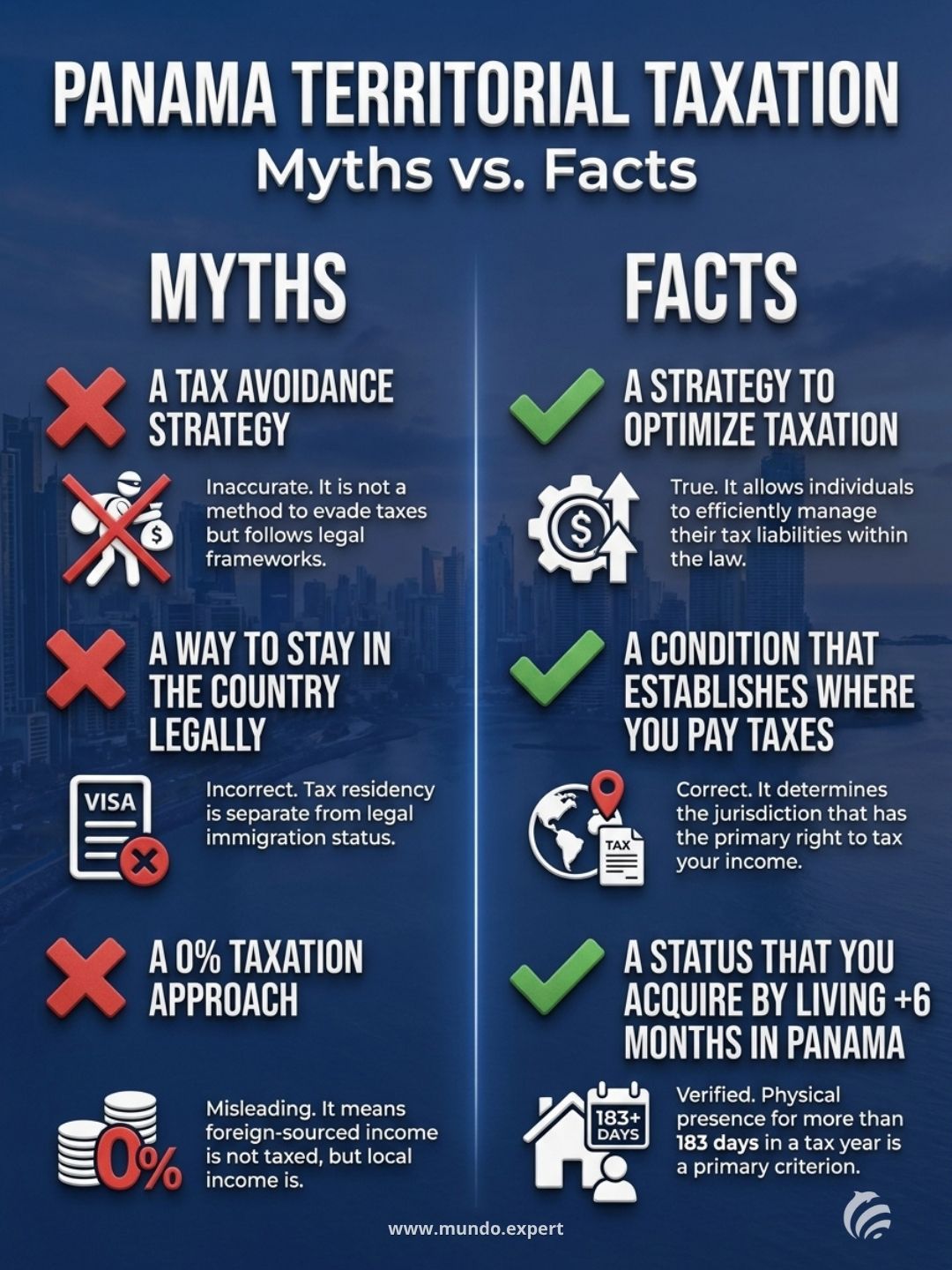
The first thing we need to clarify is that a territorial system has nothing to do with avoiding tax. In simple words, it means that the country doesn't levy taxes on assets located abroad.
Therefore, we can easily deduce that, for the strategy to be effective, the person has to live in the country for the largest part of the year (more than six months), hold a legal resident status, and keep the largest assets abroad without wiring them to Panama.
Finally, it should not be mistaken for a zero-tax approach, because residents will eventually need to hold assets in the country (for daily payments, rent, tuition, etc.). For instance, if they own a place in Panama City for their main residence and a secondary apartment in Boquete, both properties will be taxable, as explained further down.
Becoming a Panama Tax Resident
Before you become a tax resident, become a legal resident
The reason why Panama is such a coveted tax residency hub is that it allows you to become a legal resident first. As you can infer from the above paragraphs, you must have a physical presence. Naturally, you'll eventually need formal residency, as you can't extend a tourist visa indefinitely. Therefore, a country that facilitates legal residency becomes a strong candidate for the territorial approach.
Ways to obtain legal residency in Panama
Qualified Investor Visa
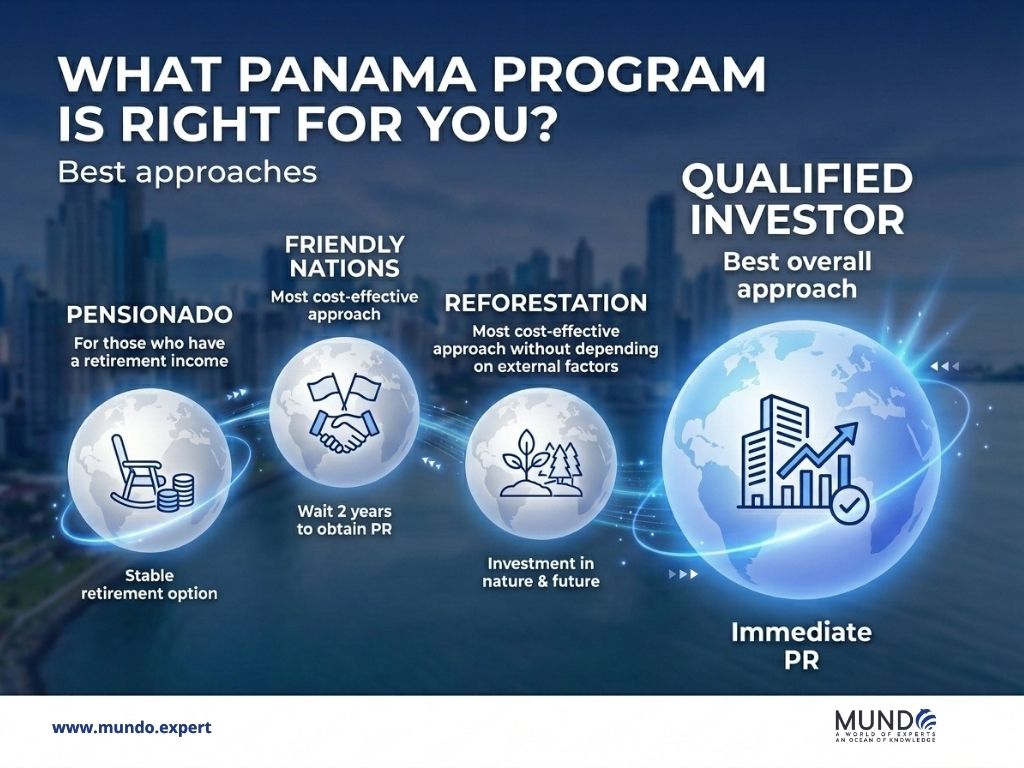
We mention the Qualified Investor first because it's the most comprehensive program available, providing immediate permanent residency. The entries are an investment of $300,000 in real estate, $500,000 in the stock market, or $750,000 in a fixed-term deposit. In all cases, the funds must come from abroad and from legit, verifiable sources, and the investment must be held for at least five years.
Friendly Nations Visa
Another option is available for a lower investment. With a $200,000 fixed-term deposit or real estate purchase, the applicant can obtain a 2-year residency. Initially, it's only available for citizens of countries that are considered to have friendly relationships with the Republic of Panama, provided they demonstrate having a financial connection to the country.
Although Friendly Nations has been overshadowed by Qualified Investor (which grants permanent residency with only $100,000 more), it’s still a viable option for qualifying individuals. Especially those who are not looking for a permanent stay or don't mind waiting two years before obtaining a permanent status.
Reforestation Program
Through the reforestation program, the government grants residency eligibility to those who invest in land. The program focuses specifically on reforestation projects, that is, planting teak trees and collecting the wood after twenty-something years. This makes it an ideal alternative to benefit from returns in the long term while obtaining Panama residency.
Its two-layer threshold makes it flexible, allowing you to choose between a $100,000 investment obtaining a 2-year permit, and a $350,000 investment, obtaining permanent residency.
This makes it 1) the most accessible residency program, and 2) the most expensive investment option. All in all, applicants choose it because of its flexibility, especially the lower entry, which constitutes the lowest investment among all programs without depending on a pension or nationality.
The 183-Day Rule and the Center of Economic Interests
Panama follows the same rule as most countries, defining a tax resident as anyone who lives in the territory longer than six months each year. This can be used to plan accordingly, but it can also mean that if you overstay your welcome, you may become taxable without even knowing it.
Tax Residency vs. Legal Residency (migration): Two Different Statuses
Legal residency | Tax residency | |
Main purpose | Obtaining the right to live in the country without restrictions | Optimizing taxation through careful planning |
How it’s acquired | Through residency programs | By spending over 6 months a year in a country |
Advantages | Opens the doors to banking, investing, doing business, and free travel in and out | Territorial taxation allows you to reduce tax burden by maintaining your strongest assets abroad and living in the country |
How to maintain the status | Keep the investment for at least five years and visit every couple of years | Spend +6 months a year in the country, each year continuously |
Responsibilities | Maintain your investment and comply with the law | File taxes annually in Panama, for both local and foreign income, even if taxed at a zero rate (consult with a tax expert) |
Ideal for | Applicants seeking full relocation or a flexible second residency | Applicants seeking a convenient tax residency as part of a wider financial strategy |
What Is Taxed and What Is Not
Panama-Source Income: Rates and Brackets
Since physical presence is required, it's impossible to avoid paying tax in Panama, as domestic-sourced income or income received in the country is taxable. Still, Panama is considered to be within the tax-friendly range when compared to other jurisdictions, especially the largest Western powers.
These are some of the taxes you will be subject to:
- Personal income tax for individuals living in Panama
- Corporate income tax for companies established in the country
- Social Security contributions for employers and employees
- Capital gains
- Dividends
- Property tax (varies for main residences and secondary or commercial property)
- Franchises tax
- Value-added tax (except for basic food products, medicine, educational supplies, agricultural supplies, and products for babies)
- Stamp duties
- Municipal taxes on business activities (depending on the activity and the income)
Foreign-Source Income: Dividends, Capital Gains, Royalties
All foreign-sourced income and assets, like real estate, dividends, capital gains, royalties, or salaries, are exempt for residents of Panama. They are only taxable on the assets they receive in the country, for example, if they wire themselves money to their Panamanian account, or if they receive dividends from a local company.
Property Taxes and the Primary Residence Exemption
Property taxes are conveniently organized into layers and differentiated between main and secondary residences or properties destined for commercial activities. The tax burden is heavier on secondary real estate.
Primary residences are exempt up to a value of 120,000 dollars, and then the taxes range from 0.5% to 0.7%. On the other hand, secondary properties are exempt up to a 30,000-dollar value, and the rates range between 0.6% and 1%.
VAT (ITBMS) and Everyday Taxes
With every purchase you make (with the exception of certain products), you pay 7% of value-added tax, which is automatically included in the retail price.
Disclaimer: this article was written based on a wide search and to provide general information about Panama taxation; however, Mundo does not provide tax advice. This article doesn't constitute tax advice or a legal consultation. All clients ordering services from Mundo are responsible for their own taxation and for procuring their own tax advice.
International Context for US Citizens
US Citizens: Why the IRS Still Follows You (FEIE, FBAR, FATCA)
The US has a specific approach, taxing citizens on their worldwide income, regardless of where they live. Any person based anywhere in the world will be taxable in the United States (and thus subject to FATCA, FBAR, and FEIE) if they have a US passport or a green card.
Since there are certain double taxation reliefs, Mundo encourages you to seek tax advice so that you can legally reduce your tax base.
Double Taxation Treaties and Information Exchange (CRS)
As a country subscribed to the CRS (Common Reporting Standard), Panama will automatically report to your country of tax residency.
If you have tax residency in any other place besides Panama, you must state it at the moment of opening an account. Besides, the bank will contact you every couple of years to confirm this information.
In this regard, we strongly recommend that you are fully open at the time of filling the bank applications and disclosing any country where you might be taxable. It’s vital to consult with specialists in all jurisdictions involved, as often a person can be taxable without even knowing it.
Conclusion: A Tax Plan Before You Move, Not After
The bottom line is: always plan ahead. If you were thinking that territorial taxation is some kind of magic wand that will miraculously exempt you from all forms of tax, you were wrong. Territorial taxation is a strategy that should be analyzed with your tax advisor, who should ideally specialize in international taxation or, at least, in the jurisdictions involved.
Who we are
Mundo is an advisory firm specializing in second residency and citizenship, banking, corporate, trusts, and real estate. However, keep in mind that we don't provide tax advice, so we encourage you to seek a reliable professional to help you in this regard.
In June, our CEO went to two conferences in Barcelona and Paris, while three of our team members visited the real estate Expo (MPIF) in Moscow. These are only a few of the events we're planning to visit this year, because Mundo is committed to presenting Panama to the world.
Contact us for company incorporation in Panama, Seychelles, Hong Kong, the UK, the US, and many other jurisdictions, for trusts in Nevis, Panama real estate and residency, and many other services geared to help you fulfill your financial goals.


.png.small.WebP)


.webp.small.WebP)


$347,000
$309,100
$300,000
$250,000
$424,000
Since this African island nation launched its citizenship by investment program last year, it has be...
Sunshine, warm temperatures, tax advantages, and a cosmopolitan ambiance attract expats from differe...
Geopolitical conflicts, increasing taxation, and over-regulation have historically driven middle- an...
When pursuing migration investment, applicants must pick one of the available entries, which general...
From all the factors that drive expats and retirees to choose one specific jurisdiction, healthcare ...
When discussing Panama residency, we often mention the old-time favorites: Pensionado, Friendly Nati...