







Nevis Multiform Foundation vs Traditional Trust: Which Structure Fits Your Family Office?
From all the structures dedicated to protecting one's assets, the trust has been consistently the favorite tool. However, on the island of Nevis, there are other options just as protective, like the Nevis multiform foundation. Let's find out what you know and what you don't know about this hybrid structure that focuses on protection while providing flexibility.
Why Open a Nevis Trust in 2026: Ultimate Asset Protection for US and Canadian Families
In the 21st century, the concepts of Nevis trust, asset protection, and wealth planning are almost synonymous because this island is one of the main trust jurisdictions in the world. If you browse around our articles from five years ago, you will see we have featured other jurisdictions. Yet in the past two years, we have focused mainly on this Eastern Caribbean gem. We're not talking about offshore havens or shady ways to circumvent the law: we are talking about a serious and legal strategy that can help you even if you are not a tycoon. This is our dedicated article on the Nevis trust.
The Five Flags Strategy in 2026: How US and Canadian Citizens Can Optimize Global Freedom
Talking about the five-flag theory is talking about wealth and how to preserve it for generations. More than a strict set of rules, this is a philosophical concept that encompasses a second residency/citizenship and financial optimization across five countries or flags. The earlier foundation of the theory was established by Harry D. Schultz, and it was soon embraced by wealthy families throughout the decades. Entering the second quarter of the century, with geopolitical conflicts and other concerning threats rising, we believe that the five flags are more vital than ever.
Open A Trust and Sleep Soundly: Transfer Assets to a Trustee and Keep Them Safe From Harm
People usually start thinking about the future when they realize how much time and attention their property actually requires. Managing family wealth isn’t only about money — it’s also about responsibility, which can become tiring when every choice has financial consequences. That’s why many families seek a structure that eases pressure, distributes the duties, and establishes clear, predictable rules.
Premium Standards For Estate Planning Services Through Trusts
Every decision concerning your wealth and its preservation requires trust — both in the structure and in the people who create it. Mundo embodies this trust through a framework built on Nevis, refined by decades of international experience. Those who choose Mundo’s premium service gain a carefully designed system where every action serves one purpose — the preservation of assets and long-term peace of mind.
Strength In Law: The Three Principles Of A Trust
Sometimes a single document can determine the fate of entire generations. A trust can be a highly protective structure or leave the assets entirely vulnerable to claims. These structures are based on three principles that hold together all the power of the trust, which is enhanced by the laws of the country. We delve into timeless rules that provide the answer to what is a trust made of, forming the very foundation of security and continuity.
When To Open A Trust In Nevis: Asset Protection At Every Stage Of Life
Life often feels like a long journey. At twenty, ambition and independence shape our first steps; at thirty, family, children, and a new home take center stage; by forty, experience, investments, and business define our stability. Then comes the inevitable question: how can we preserve all that we have built and pass it on securely? In this article, we will explore several key moments when the decision to open a trust becomes clear and how a Nevis trust offers the reassurance.
Asset Protection And Control: Differences Between A Nevis Multiform Foundation And A Trust
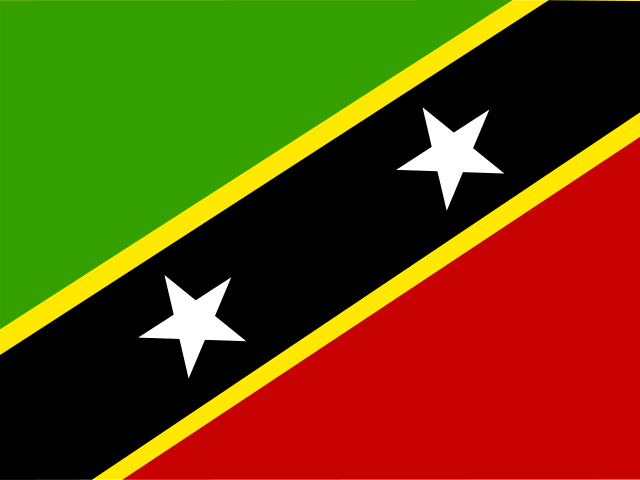
Choosing the right jurisdiction for asset protection and control of your estate is an important decision, but what about the structure? When considering such queries for our financial planning, it is imperative that we understand the difference between trust and foundation so we can make our choice accordingly. We've consulted with our experts about how to set up a trust for your business, about the characteristics of a trust, what makes them strong and what makes them weak, and, finally, about its elements and players. In that conversation, we've touched upon the trust and foundation. The principle of asset protection is separating those assets from your ownership, and, to do this, it's important to count on structures like a trust and foundation. However, not only do these two have their differences, but they also have separate features depending on the jurisdiction. Today, we'll talk about the island of Nevis, which is part of the Federation of Saint Kitts and Nevis. Being totally straight, we don’t usually hear about Nevis often except when it comes to business or asset protection and control. Its LLC structure is one of the most renowned in the world when it comes to privacy and efficiency, offering solutions that run head-to-head with Delaware or Florida. In summary, if you're asking yourself how to set up a trust for your business, Nevis should be among your top 5, if not directly in the first place. Its strongest advantage is that it only recognizes local court rulings, thus discouraging unfair claims and ungrounded plaints. To put it simply, we can say that, if the trust is properly stipulated, it is truly unbreachable. Purpose may be the main difference between trust and foundation. A multiform foundation in Nevis has special characteristics and is ideal when the family wants to use the assets. A charitable foundation, for example, can collect donations, create institutions (like a church), or participate in various activities. On the other hand, the trust is solely about asset protection. The main goal in this case is to separate the assets from their owner, and from that moment, the owner has absolutely no control. The reader should pay special attention to this point, as this could significantly weaken the trust if not properly addressed. In Nevis, the founder of a foundation can manage the assets, which is exactly the opposite to what can be done in a trust. The settler of a trust loses complete control, hence the structure’s protective capabilities. When it comes to beneficiaries, a trust requires them to be thoroughly stipulated, while in a charitable foundation, they can be broader, like the members of the community or a group of people. This is why a charitable foundation is ideal for philanthropic activities. Here we find a key difference between the two structures, taking us back to point number one: purpose. While a foundation can exist without assets, a trust can't. A foundation is an entity that owns certain property; on the other hand, a trust is an agreement in which you trust your assets to a third party. This is why a trust cannot exist without assets, because it wouldn't be a trust. When asking yourself how to set up a trust for your business or your family's wealth, think about the goal. If you want to protect the assets for some reason, like establishing a charitable foundation, then this may be the right way to go.
Setting Up A Family Trust: Three Mistakes That Can Make Your Trust Weak
The matter of asset protection can be both challenging and puzzling, especially if you don't have the correct guidance. Today, we go deep into the subject of the three mistakes that you can make when you establish a trust, and that can eventually jeopardize it. The whole point of setting up a family trust is to protect a family’s properties, valuables, companies, and investments (in simple words, all the family's wealth) from creditors or persons who intend harm. Yet we can't overlook the fact that this level of protection is only put in motion if the trust is, indeed, strong, and for this, there are several aspects to consider. Today, we introduce to you the three main mistakes that can make a trust weak and leave the assets unprotected. The trust protects the assets because it's an agreement that separates legal ownership from the settlor. If an individual renounces the right to use those assets and to benefit from them, then these cannot be taken away or seized. The property that once belonged to a person is now destined to benefit others, who are, generally, relatives or loved ones of the original owner. Give or take, this is the essence of a trust, and this is what needs to be respected if you want actual protection. Before we continue with the topic, we would like to point out the importance of choosing the right jurisdiction. In the island of Nevis, for instance, the trust legislation is solid as a rock because it doesn't take foreign rulings into account. To paint a simple picture, let's just say that to challenge a trust in Nevis, you have to go through a legal process within the jurisdiction. One needs only to imagine the hassle and expenses of doing this from abroad, and we immediately understand how this may discourage unfair allegations or ill-intentioned claims. With that said, no jurisdiction on the planet will be safe enough if you don't consider the basics. Before we describe the three mistakes of setting up a family trust, we need to understand what would make it weak and leave it at the mercy of litigants. This takes us back to the first paragraphs and the purpose of a trustee agreement: losing control of the assets for the benefit of a third party. If someone can prove that the trust was created for any other reason, it can be dissolved. A trustee has the power to decide over the assets, and if the settlor is the trustee, it means he/she is still in control. As a result, the structure can be seen as a sham trust, and your creditors may take advantage of this. Once you have appointed a trustee and signed all the documents, assets must be transferred. Any property, valuables, stocks, or assets of any kind must actually be under the trust. If you fail to implement this, the trust will be sham, and this can be proven in court. If you create a revocable trust, you, the settlor, will have some level of power over future decisions. Now, if you are trusting your property to a third party, why would you want to maintain control? Such a decision can be seen as an attempt to deceive tax authorities or any other organizations. If you don't trust, don't establish a trust. The main lesson here is that a trust is a decision in which you relinquish control.
How Do You Set Up A Trust with Mundo Packages
Choosing to set up a trust can be a decisive step toward long-term asset protection and generational security. For many clients, the most common question is how do you set up a trust that balances flexibility, confidentiality, and safety. Mundo offers tailored trust solutions with three levels of service, each designed for a different depth of involvement and legal services. From a simple formation to comprehensive legal structures, we make trust management intuitive and secure. How do I set up a trust? Before even considering legal documents, clients need clarity and a structure that adapts to their particular circumstances. Mundo begins with an in-depth consultation to identify your financial goals, asset types, and risk tolerance. We then match you with the right option, whether it’s the bronze package, the silver package, or the gold package. If you are wondering how do you set up a trust that fits your vision of protection and long-term strategy, then taking a look at these packages may help. When people ask how do I set up a trust, they’re often seeking clarity, confidence, and a sense of security that goes beyond technical instructions. Our team offers guidance on the private trustee company model, asset-holding vehicles like Nevis LLCs, and the legal roles of each party. By framing your structure correctly from the beginning, we ensure compliance, clarity, and international adaptability. The bronze package is ideal for those who need a reliable starting point without complex customization. It includes the preparation of the trust deed, registration of the private trustee company, and appointment of a professional director. While Mundo provides the legal structure and guidance for setup, the ongoing administration remains the client’s responsibility. This option suits those who prefer to manage their trust independently once it is legally in place. We are often asked how much does it cost to establish a trust. The answer depends on your selected package and structural requirements. The bronze package is the most accessible option, designed for individuals or businesses who have some experience in structural planning, taxation, and compliance, and who can look after their trusts after establishment. Contact us directly to receive a customized quotation based on your needs. Clients who want more operational support often choose the silver package. It includes everything in the bronze package, plus optional bookkeeping, creation of a Nevis LLC (if required for asset holding), and more comprehensive management. However, this package does not include transfer of ownership, legal opinion, tax advice, or international legal expertise. It is a solution for those seeking premium services while remaining involved in key protection and structuring decisions. The silver package is also ideal for evolving structures. As your assets grow, you may need additional legal components or asset classes. With Mundo’s help, your trust can expand without requiring a full redesign.
$170,000
$2,500,000
$350,000
$1,400,000
$395,000
International publications like Forbes have consistently chosen Panama as one of the best retirement...
Foreigners have been looking at Panama real estate for various reasons. Price, quality, lifestyle, a...
In a country with two oceans, apartments in coastal environments are highly coveted. They can be sui...
When making a significant investment, a careful approach is needed, even more so if this investment ...
The country of the canal has consistently been chosen as an expat and real estate destination. With ...
.jpg)