














Common Mistakes When Setting Up a Nevis Trust: Pitfalls for US and Canadian Investors


Diving into the Nevis trust
For centuries, the trust has been a tool used by families to protect their estate and assets, from property to jewelry or companies. Today, we choose another perspective to analyze the Nevis trust setup: mistakes that can make it weak and render the assets vulnerable.
Even the strongest fortresses have weaknesses, and you need to know them, so you don't let harm come your way.
What is a trust
To put it simply, this is an agreement between two parties. One has assets or estate that he or she wants to protect, and transfers them to the second party for management and protection. The goal is to distribute the assets in a specific way (which has to be previously stipulated in the trust deed) and to specific persons. These are the beneficiaries.
Differences with other structures
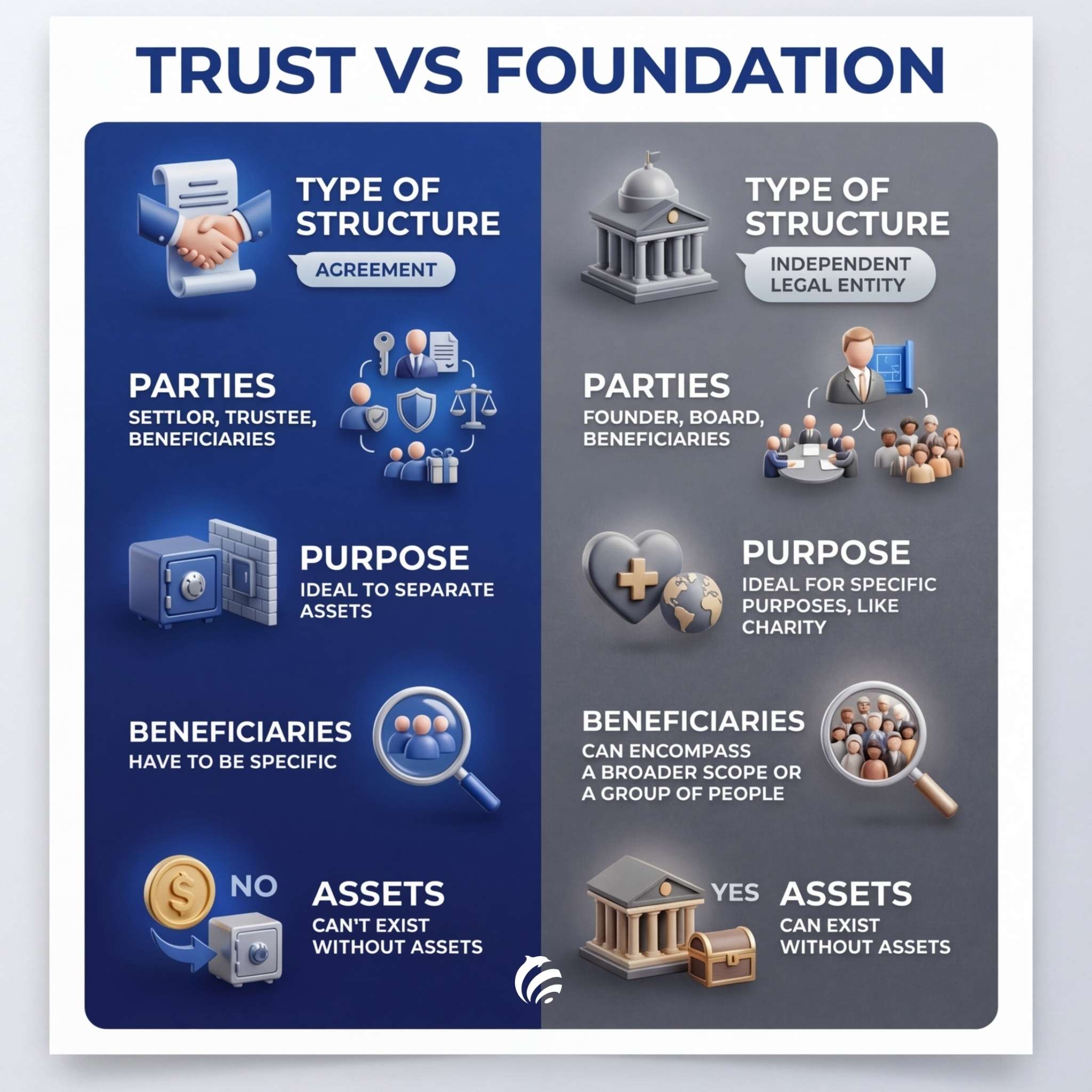
The trust is often mistaken for the foundation because these two serve similar purposes. Both separate ownership from the original owner, and they both benefit third parties. However, the foundation is an entity while the trust is in agreement. It can only exist if it has assets, while the foundation can exist with no assets.
A foundation is a registered entity that has a board of directors. They will oversee the activities while in the trust, this role is fulfilled by the trustee. Whether an individual or a company, the trustee is the one holding and overseeing the assets.
Finally, foundations can benefit broader groups (the members of the community, the members of an institution, children living in specific areas). On the other hand, a trust has specific beneficiaries who should be stated by name and duly identified.
Choosing a jurisdiction for your trust
With a trust, jurisdiction is everything because the legislation is what makes it more or less protective. It is what shelters the assets or leaves them open for claimants or ill-intended players. Let's go through some of the best countries for asset protection today.
Cook Islands
The Cook Islands are known as one of the best places to protect assets because they have legislation specially geared for such a purpose. The access on behalf of creditors is limited, and it doesn't accept rulings from foreign courts.
Even if the claimant is successful in another nation, in the Cook Islands, they will have to start the process all over again. Furthermore, all claims must be started within two years after establishment and no later.
Cayman Islands
What distinguishes Nevis and the Cook Islands is their strong barrier against claimants. In the Cayman Islands, families find fewer barriers and more complex legislation.
Therefore, the Caymans are chosen by those who focus on estate planning rather than protection. In this regard, the nation offers outstanding solutions within a sophisticated legal system that supports discretionary trusts.
Nevis
On the island of Nevis, we find a structure that has been described as the Fort Knox of trusts. Even though it competes in level protection with the Cook Islands, it is one of the favorite choices among wealthy families.
Nevis doesn't recognize foreign rulings, and it establishes a 2-year period for filing claims after the trust is formed. So far, it’s similar to the Cook Islands. Nevis goes one step further and stipulates a $100,000 bond to start any legal action.
What is an offshore trust?
The word “offshore” has been misinterpreted and associated with shady practices, money laundering, or tax evasion; however, this is the result of misunderstanding the term.
About the term offshore
The definition of offshore by the Cambridge dictionary is “away from or at a distance from the coast”. So, in the past, they used to call “offshore” those entities that were based in a country while operating in another one. Thus, the country of incorporation allowed them to operate tax-free as long as the operations were elsewhere.
Nevertheless, this ended with the appearance of the economic substance regulations. Now, the term “offshore” is used to describe countries or structures that provide friendlier conditions for businesspeople and investors.
They don't facilitate tax avoidance or the concealment of information since now all countries report automatically through a system called CRS.
Types of trusts
The structure takes on different forms depending on the purpose.
Revocable trust
These can be altered during the settlor's life. This is why they are highly flexible and ideal for those who need to maintain some control.
Discretionary trust
With a discretionary trust, the trustee has full control over how to manage the assets. These are ideal as long-term strategies as they allow you to adapt to the family's changing needs. It's very hard to predict what will happen in the future, how many of the children will have more children, how many of them will go to college, how many of them will move abroad, etcetera. With a discretionary trust, the trustee can make decisions based on current needs.
Testamentary trust
These are usually created through a will. Assets are released after the settlor's death. Parents choose this solution when their children are still young to protect them in case of the parents' death.
Spendthrift trust
These are established to limit the beneficiaries' access to the assets. They protect against irresponsible relatives or spendthrifts.
Taxes and reporting
Like with any financial structure, trusts and their assets must be reported in your country or countries of tax residency. All the trusts are often advertised as tax-free vehicles, but they are not. In the jurisdiction of Nevis, there is a territorial taxation system under which all foreign assets are not taxed on the island.
This means that your foreign assets won't be taxed in Nevis, but they may be subject to taxation in other countries. This is why Mundo strongly suggests that the family consults with a tax expert or tax experts in the different jurisdictions involved.
Mundo's expert opinion by Karina Dinsberga, trust Expert at Mundo: “I am sure Nevis trusts are valued not only for their strong legal protections but also for the peace of mind they offer. These trusts are designed to safeguard assets while giving clients a high degree of control and flexibility. An engaging and experienced professional is essential to ensure the trust is properly structured, compliant, and aligned with the client’s long-term objectives, so that the clients can be sure their wealth is shielded from unexpected claims and preserved for future generations, while respecting confidentiality and creating a reliable, long-term foundation for protecting what matters most”.
Common mistakes when setting up a trust
It doesn’t matter how effective the jurisdiction of your choice is: some simple mistakes can cost you your entire fortune. We have talked to our experts, and they have given us great insights into the matter.
Avoid retaining control
The foundation of a trust lies in relinquishing control of the assets. If you maintain control in any way, or even if it looks like you're retaining control, this can be used against you. Claimants can prove in court that your trust is invalid.
Any doubts? Send us your enquiries!
Don't use the trust to avoid responsibilities
If someone can prove that you have established a trust to avoid paying claimants, the trust will be deemed a sham trust. If you have current responsibilities, it's better to face them right away. The trust works as asset protection against future issues or potential liabilities, not current ones.
Transfer the assets
At the risk of sounding obvious, a trust doesn't exist with no assets. Failing to transfer the assets completely invalidates the trust and leaves the assets unprotected.
Avoid revocable trusts
Following the same principles stated above, a revocable trust can be seen as an attempt to maintain ownership. Full protection comes when you separate yourself from the property, so if you are not willing to do this, it's better not to establish a trust at all.
A good approach is to leave some assets out of the trust so that you can still control them. Meanwhile, the most important ones (like college funds for children, the family's main residence, or the company from where you obtain your main income) are kept safe.
How to set up a trust: Key steps
Step 1: Schedule Your Consultation with a Mundo Expert
The first step on your journey toward asset protection is reaching out to our team to book a complimentary consultation with one of our seasoned Mundo specialists. During this session, our experienced attorneys will take the time to listen carefully to your goals, understand your financial situation, and explore your specific needs in depth.
No two clients are alike, and we pride ourselves on crafting tailored solutions rather than one-size-fits-all approaches. Together, we will identify the most effective and efficient way to structure your trust so that it aligns perfectly with your long-term objectives.
Step 2: Receive Your Documentation Package
Once the initial consultation is complete and a clear path forward has been identified, your dedicated Mundo representative will reach out with our invoice, and, once this is settled, you will proceed to send us your documents.
We understand that compliance procedures can feel overwhelming and time-consuming, which is why our team works closely alongside you to simplify and accelerate every step of the process, ensuring nothing falls through the cracks.
Step 3: Begin Due Diligence
At this stage, you will be introduced to your personal Mundo relationship manager — a dedicated professional who will serve as your primary point of contact throughout the entire engagement. They will keep you informed, answer your questions promptly, and guide you through each subsequent milestone with clarity and confidence.
Step 4: Drafting, Reviewing, and Executing the Trust Deed
With due diligence successfully completed, our legal team will move forward with preparing your trust deed. This critical document will be carefully drafted, thoroughly reviewed, and refined through a collaborative process to ensure it accurately reflects your intentions and complies with all applicable legal requirements.
Depending on the package you have selected, we may also coordinate with an independent attorney to obtain a formal legal opinion, providing an additional layer of assurance and credibility to the overall structure.
Step 5: Official Establishment of Your Private Trust Company in Nevis
The final step is the formal incorporation and establishment of your Private Trust Company (PTC) in the jurisdiction of Nevis. At this point, your structure is fully operational, legally sound, and ready to serve its intended purpose. Our team will ensure a smooth handover and, depending on the package of your choice, we can offer several other complementary services.
Main uses and advantages of a trust
Who can establish a trust
Such tools have been associated with the ultra-wealthy for decades, simply speaking, because they use them. Nevertheless, thinking that trusts are only for HNWIs is a mistake. You can protect anything within a trust, even if it's just an apartment, a bank account, or a small company.
Why establish a trust
- Estate planning
- Avoiding long and expensive succession processes
- Choosing whom to leave your assets to as an alternative to a will
- Protecting the family's wealth from potential threats in the future
- Protecting the family's wealth for the use of the children or grandchildren in the future
- Maintaining funds to be used for specific purposes in the future (paying for college is a clear example)
- Protecting the assets from threats within the family, like spendthrifts or irresponsible children
- A family can set up a trust to limit the beneficiaries' access to the assets and teach them the value of money, encouraging them to make money of their own
Practical uses of the trust: Case studies
Case study one: Jack and Lorraine
Jack has been successful in his businesses and has accumulated a nice fortune. However, Jack and his wife, Lorraine, notice that their children have grown up with extreme comfort and don't appreciate effort.
So, they establish a trust and stipulate that the children can obtain a yearly sum only if they have earned that amount by their own means. Thus, they can use the family's wealth but only if they have worked hard to obtain their own money.
Case study 2: Matthew and Jacqueline
Matthew and Jacqueline are both doctors. He's a surgeon, and she's an anesthesiologist. They have large savings and also inherited several properties from their parents. They know that their profession is highly risky and that they are prone to claims that may jeopardize the family's estate. Therefore, they create a trust and put all their apartments and their main savings account under it.
Case study 3: David and Beatrice
David and Beatrice work hard for their money, and they have managed to save a good amount for their children's college. To make sure this money is protected (and that even they cannot touch it in an emergency), they put it in a trust and establish that the money is released when their children start college, and that the funds will be used exclusively for tuition.
Disclaimer: all study cases are hypothetical. This article doesn't constitute legal advice. The information provided in this article may be inaccurate or outdated at the time of reading. Before establishing a trust, always consult with certified professionals.
Frequently asked questions about trusts
If I start a trust in Nevis, will I be free of tax?
No. Your foreign assets won't be taxed in Nevis, but you may be subject to tax in other jurisdictions.
Does my Nevis trust have to file tax reports?
No. It's not mandatory for Nevis trusts to file taxes each year, but they are obliged to maintain financial records within the jurisdiction. Such records must always be available. Furthermore, you may be obliged to file a tax return for your trust assets in other jurisdictions where you are tax resident.
Can I be a settlor and a trustee?
No. The essence of the trust is that you relinquish control over the assets. So, the original owner can't be the trustee.
Do trustees have to be members of the Board of Nevis?
Not necessarily. Private trustees are also allowed.
Can the Nevis trust have co-trustees?
Yes. As long as the main trustee is in the jurisdiction of Nevis, there can be co-trustees, and they can be in other countries.
Is it mandatory to appoint a protector?
No. A protector is a person whom you can appoint optionally, if you want someone you trust to oversee that the trustee actually fulfills their role correctly and according to the trust deed.
Can the trust deed be amended?
Yes, but only in some cases.
Final thoughts on establishing a trust in the jurisdiction of Nevis
To sum up, if you want to start a trust, do it in the right way. Do it in a jurisdiction where your assets will have the best protection they can get. With a 2-year statute of limitation period, with no recognition of foreign court rulings, with the mandatory $100,000 bond, and with its long history of protecting assets, the island of Nevis is a safe place to take care of what's important.
Like we've stated recently in another article: at the end of the day, you won't be protecting money, properties, or jewelry; you are actually protecting the ones you love.
How can Mundo help you
We have wide and long experience establishing trusts and providing other types of services focused on the global investor and perpetual traveler. We can open companies and bank accounts for you, we can help you choose real estate abroad, and we can assist you in the process of obtaining a second residency or citizenship. Contact us, and we will help you fulfill your goals and upscale your financial and relocation plans.


.png.small.WebP)


.webp.small.WebP)


$347,000
$309,100
$300,000
$250,000
$424,000
Panama enjoys a rare combination of factors that contribute to making it a real estate hub in the re...
When there's a new program in the CBI world, everyone talks about it. Comparisons are common between...
Today, we go back to analyzing the new African CBI program, which has been on the lips of experts an...
The migration world has been increasingly tied to finances since wealthy people started to choose sm...
The financial world is facing dramatic changes, and structures need to be ready to accompany clients...
When discussing asset protection, there are several myths, marketing lines, and promotions; hence, i...